

My jon boat is fourteen feet long and most of its storage is a bench seat with a lid. For years I fished out of one big tackle box that rode behind my feet, and every trip started the same way: open the lid, stare into a pile of crankbaits and hooks, dig for the one I wanted, then give up and tie on whatever was sitting on top.
A couple of seasons back I moved to KastKing Utility Tackle Boxes, the 3600 trays that come two to a pack, and I have not carried the big box since. Not because trays are fashionable. Because ten specific things about them make a day on the water easier, and I can name every one of them. These are in the order I noticed them.
Ten reasons, one shallow tray: see every bait without unpacking the bag
Two 3600 trays, up to 18 compartments each, 10.8 by 7.25 by 1.65 inches. They drop into the tackle bag you already own.
Amazon Check Today's Price on Amazon →You can see every bait in the tray at once
A big box is one deep cavity with a tray or two floating on top. Whatever sank to the bottom stays there until you dump the whole thing out. The KastKing trays are compartments all the way across, so when I open one I am looking at every bait in it. No reaching past the top layer, no phone flashlight at 6 a.m. On a drifting boat with Tyler already casting, finding a specific craw in four seconds matters. Before this I tried a two-tray insert that dropped into the top of the big box. It lasted one trip. The trays sat so high the lid would not shut over the line spool I keep in the corner, and I was back to digging by July.
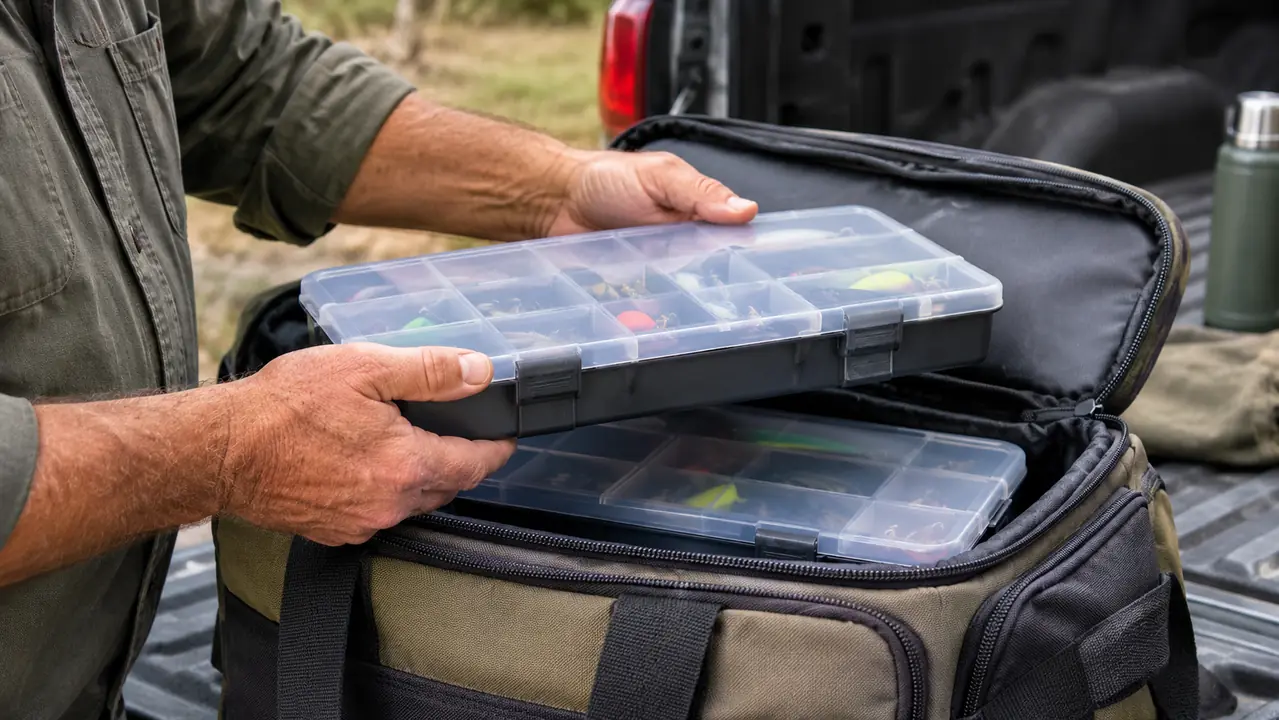
It drops into the tackle bag you already own
3600 is a size, not a brand promise. These trays are built to be interchangeable with standard tackle bags, which means the soft bag that has lived in my truck bed for a decade still works. I did not buy a new bag. I moved the old one from the garage shelf to the boat, loaded two trays into it, and left the big box on the shelf where it still sits.
Three to eighteen compartments, decided by you
The dividers are pre-cut, so you break out the ones you do not need. Terminal tackle and hooks want a lot of small compartments. Lipless crankbaits want three long slots. Same tray, different job. I set one up for panfish and one for bass and river smallmouth, and I have not had to dump a tray and start over since I did it. The panfish tray got built in March, before the ice was off the inland lakes, with eight small compartments down one side for jigs and split shot and two long slots on the other for the tiny crankbaits I throw early. It has not been rearranged since.
Two to a pack covers two trips without repacking
The pack is two 3600 trays. That is enough for a summer of quick after-work trips plus a Saturday on the river. One tray rides in the bag, the other stays in the garage already set up for next time. When Tyler comes along he takes the spare, and I do not have to listen to him ask where the bluegill jigs went.
The footprint fits a fourteen-foot boat
At 10.8 inches by 7.25 inches by 1.65 inches, a 3600 tray slides under a bench seat or into a side pocket and stays out of the casting lane. My big box had to live in the middle of the floor. Everything I own got kicked at least once a season, and one rod guide paid for it. Thin trays solve a boat problem that has nothing to do with fishing. The truck bed is the other half of it. That old box slid around back there on every turn, and the trays stack flat inside a milk crate that stays put behind the cab.
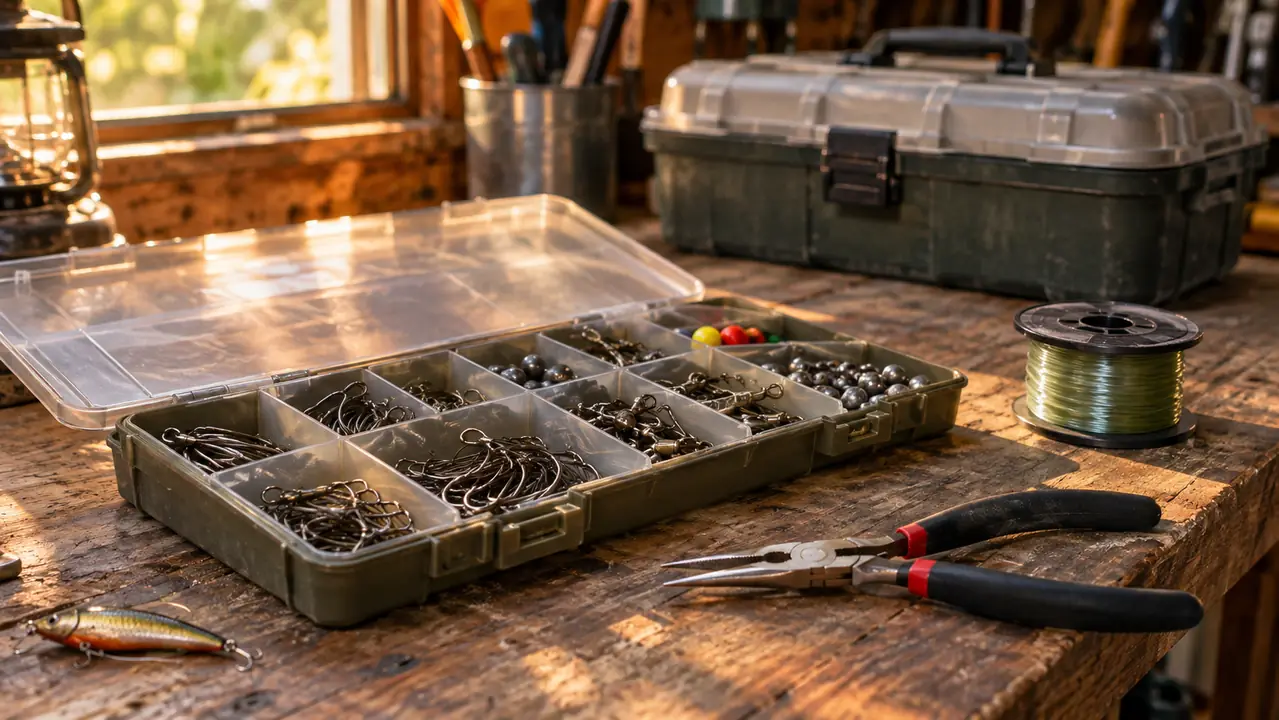
Eighteen compartments stop terminal tackle from becoming one object
Split shot, swivels, hooks, weights. In a big box these all migrate into a single lump at the low end. Each tray gives you up to eighteen compartments, and each one holds a category. I can pull a hook without turning the tray upside down over open water. That sounds like a small thing until you have done it in the dark with cold hands.
The plastic is rated waterproof, and the bilge is not
The trays are plastic with a waterproof rating. My bilge collects an inch of water on a choppy day, and anything sitting on the floor gets wet. A tray that does not soak up lake water is a tray whose hooks do not come out orange in July. I still set them out to dry at the end of the day, but I am not rescuing them. We got caught in a two-hour rain on the river in August, the kind where you bail with a coffee cup and quit fishing. The bag was soaked through. The hooks inside the tray were dry when I opened it that night.
The weight limit is stated, and it is honest
Three pounds is the maximum recommended load per tray. That reads like a limit until you weigh out three pounds of jigs and hooks and realize it is a lot of hardware. It also tells me nobody is pretending a plastic tray will hold a downrigger ball. I load to the line, the tray stays flat, and I know when to stop.
A season change takes five minutes, not an evening
Pre-cut dividers mean the layout is not permanent. In April I want small compartments for crappie jigs and split shot. By July the river box wants long slots for tubes and swimbaits. I break out two dividers, redistribute, done. A big box with molded-in trays cannot do that without buying inserts that cost more than the box did.
The gear comes apart into pieces small enough to carry
At the end of the day I do not haul the whole kit into the garage. I pull two trays out of the bag, set them on the bench, and I am finished. When I fish the South Haven piers in the fall, one tray with spoons and a few jigs rides in the truck cab with me while the bag stays in the bed. That is the real advantage of trays. Nothing is welded to anything else. Last October I walked out on the pier with one tray under my arm and left the bag in the truck, and I never once wished I had the rest of it.
What I'd Skip
Tray systems are not better at everything, and I would rather say so than sell you something you do not need. If you fish one lake with one technique and you own eight baits, a single small box is simpler and nothing on this list will change your day. Trays also multiply. Two becomes six becomes a wall of plastic on a shelf, and a tray you never open is just clutter with dividers in it. And if you carry bulky items like pliers, a scale, or a bulk spool of line, none of that fits in a 1.65-inch tray, so you still want a bag with pockets for the odd stuff. The last thing I would skip is paying extra for a name on the bag when the trays are the parts doing the work. The KastKing trays are the useful half of the setup. Buy those, use the bag you already have, and spend the difference on line.
My big box had to live in the middle of the floor. Everything I own got kicked at least once a season.
Buy the trays, keep the bag you already own
KastKing Utility Tackle Boxes come two to a pack in the 3600 size, plastic, waterproof rated, up to 18 compartments per tray. That is the whole pitch.
Amazon See the KastKing Trays on Amazon →