

I did this out of order. The boat came first, a 14-foot aluminum jon boat with a trolling motor that has lived in my garage longer than my current truck has. I bought it used off a fella over in Paw Paw, patched two weeping rivets with marine epoxy, and told myself that was the whole investment. For six seasons it was. I fished the same three stretches of my home lake on the theory that the fish had to be somewhere in there, and I let the trolling motor pick which one on any given morning. The electronics came later, and only because my grandson Tyler got tired of watching me work the same empty water twice in one weekend.
What I bought was the smallest thing on the shelf that still had a screen worth reading: the Garmin Striker 4. A 3.5-inch display, CHIRP sonar, a transducer and mount in the box, eight ounces of weight, a one-year limited warranty. It cost less than a decent set of muskie baits, and it has changed where I point the boat more than any rod I own. Here are ten reasons it earns its spot on a small boat, in the order I noticed them.
The Smallest Thing on the Shelf That Still Reads the Bottom
3.5-inch display, CHIRP and ClearVu sonar, transducer, transom mount and tilt/swivel mount all in the box. 4.6 stars across 9,345 ratings.
Amazon Check Today's Price on Amazon →You see the drop-off before the first cast
My home lake goes from four feet to fourteen in about the length of the boat. I used to find that edge by losing jigs, and I lost a pile of them. One Saturday two summers back I went through six jigs in an hour along a break I could not see and could not remember the location of. Now I idle past it once and watch the bottom line break on the screen. Marking that break takes thirty seconds and saves me an hour of blind casting across a flat that holds nothing.
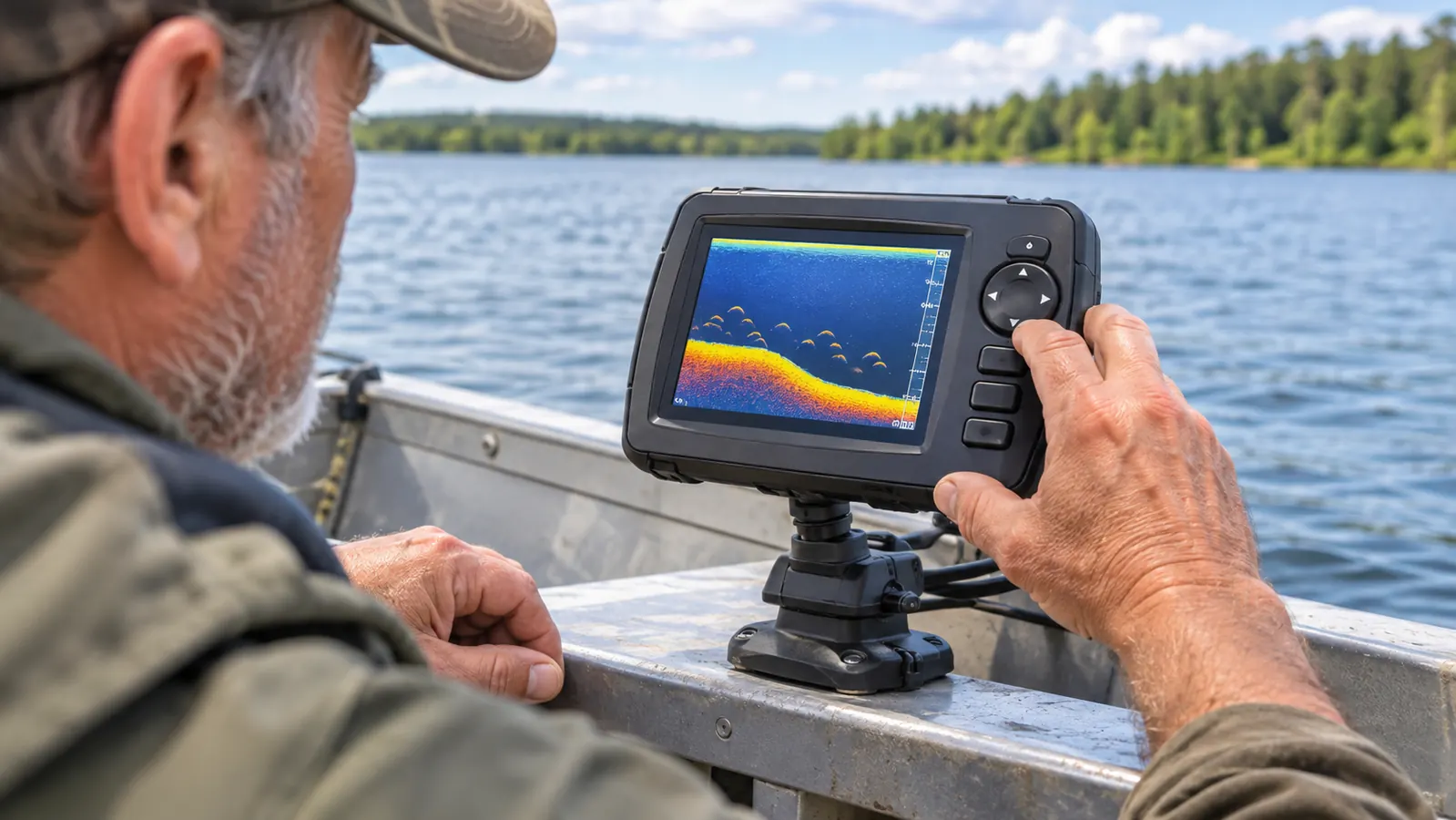
It ends the weighted-line guessing game
For years my depth finder was a bell sinker on a knotted line and a bad attitude. This unit reads depth continuously and it has far more range than I will ever use. The maximum measuring depth is 1,600 feet. The deepest water within an hour of my driveway is maybe forty. What matters is that the reading updates while I drift, not after I stop and haul the anchor up to check.
The transducer bolts to the transom and stays there
Everything you need is in the box: transducer, transom mount, tilt and swivel mount, power and data cable, documentation. I bolted mine on a Saturday morning in the garage with a cordless drill and a pencil mark, set just off the centerline where the hull runs flat. I held a straightedge against the bottom to check it, because a transducer that sits crooked will read crooked. It has not moved since, including a full season of bouncing down gravel ramps at the state launch.
Eight ounces will not pull a jon boat off course
An aluminum jon boat sits light and reacts to everything, including a shifted cooler. The unit weighs eight ounces and the mount footprint is small. I set it on the tilt and swivel mount ahead of the middle bench and forgot it was running half the time, which is the highest praise I can give a piece of boat gear.
CHIRP separates fish from structure
CHIRP sonar is the reason this little screen punches above its size. On the fixed-frequency units I have used on friends' boats, a brush pile and a school of crappie came back as the same gray smear. With CHIRP I can usually tell which is which before I drop a jig. The clearest case was a sunken Christmas tree in eleven feet of water that I had fished four times for nothing. The screen showed branches clean and no fish stacked on them, and I finally believed it and moved on instead of burning another box of minnows.

ClearVu shows you what is around the boat, not just under it
ClearVu scanning sonar gives you a picture of more of what is in the water around your boat. I use it most on the river, where a dark shape off the side could be a sunken log or the edge of a rock ledge, and the difference decides whether I drift through or pole out. On a narrow boat that read is worth the whole purchase.
The waypoint map gets you back to the same brush pile
The waypoint map lets you view, mark and navigate to spots like brush piles, stumps and docks. I mark one every time I find something worth a second pass. In August, when the weedline shifts and the fish slide off the shallow stuff, those marks are the difference between a two-fish afternoon and a mess of bluegill for the fryer. Last August I ran straight to a stump mark I had made back in June and took eight keepers off it in under an hour, without idling around the lake hunting for it first.
Dedicated buttons work with wet, cold hands
This is a keyed interface with dedicated buttons. There is no touchscreen to fight. In October on the piers at South Haven my hands are wet and the wind is off the lake and I am in no mood to swipe at glass. I push a button, the Garmin screen does the thing, and I go back to watching the rod tip.
Battery power means nothing to wire into the boat
The power source is battery power, and the power and data cable comes in the box. I did not run a single wire into the boat's electrical system or tap the trolling motor circuit. On a jon boat, every added connection is one more thing to corrode by July, and I have enough of those already.
It fits in a milk crate and rides home in the truck cab
The housing measures 3.6 by 1.6 by 5.9 inches with a 3.5-inch display, eight ounces total. It goes in a milk crate with the transducer, out at the ramp, and back on the truck seat at dark. No console, no dash bracket, and no second person needed to carry the electronics from the garage to the water.
What I'd Skip
I would skip the bigger screen. That sounds strange from a guy who just wrote ten reasons to buy the small one, but it is the honest read. On a 14-foot jon boat you sit an arm's length from the unit, so a 3.5-inch display is plenty, and a larger unit starts to eat bench space you need for a tackle box. The trade-off is glare. On a bright July afternoon I have cupped a hand over that screen more than once, and if you fish open water at midday you will too. A cheap sun shield fixes most of it. What I would not skip is taking your time on the transducer install. My first trip out I had mine mounted a hair high, and the screen went blank every time I got on plane. I dropped it an eighth of an inch, checked it again with the straightedge, and it has read clean since. Get the transom mount flat and below the hull line, or you will spend a season wondering why the bottom looks like static.
I stopped fishing the pretty water and started fishing the water that had fish in it. That is the whole return on this thing.
One Small Screen, Ten Fewer Empty Casts
Garmin Striker 4: 3.5-inch display, CHIRP and ClearVu sonar, waypoint map, dedicated buttons. Transducer, transom mount, tilt/swivel mount and power cable included. 4.6 stars from 9,345 ratings.
Amazon Check Today's Price on Amazon →