
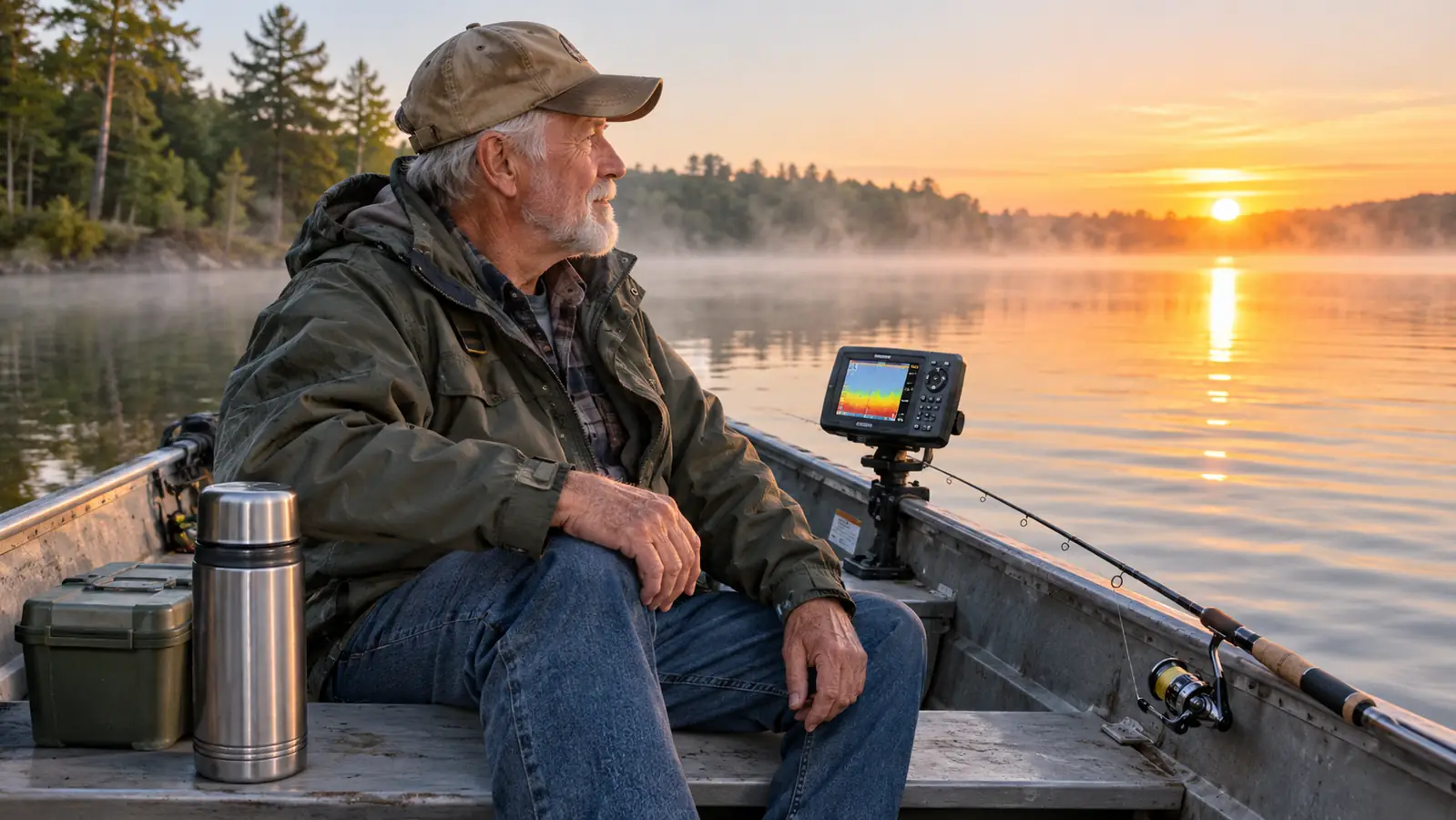
Short answer first, since that is why you clicked. If you fish from a boat you own and trailer, buy the Garmin Striker 4. If you fish from the bank, a dock, a pier, or somebody else's boat, the Deeper Start does a job the Striker 4 was never built to do. These two are not really fighting over the same purchase. One is a fish finder that lives on your boat. The other is a sonar unit you throw out on a line and watch on your phone. I have run the Garmin for two full seasons and borrowed a Deeper Start for two trips, and the honest answer is that the right pick depends on where your feet are standing when you cast.
I fish a 14-foot aluminum jon boat with a small trolling motor, mostly the little inland lakes around Kalamazoo County, with a few river trips for smallmouth and the occasional fall morning out on the South Haven piers. My grandson Tyler rides along some summer weekends and mostly wants to see the fish marks on the screen. The Garmin Striker 4 has been bolted to that boat since I retired, and it has paid for itself in brush piles I would never have found casting blind. A buddy handed me his Deeper Start for a weekend so I could stop guessing about the comparison and actually run both of them on water I know.
| Garmin Striker 4 | Deeper Start | |
|---|---|---|
| Works without a phone | Yes. The display is built into the unit, mounted in front of you, nothing else to charge. | No. Your phone is the display, so the phone comes along and has to stay charged and awake. |
| Reaching water away from the boat | No. The transducer is mounted at the transom and reads water the boat has already crossed. | Yes. You cast it out and it reads where it lands, including past the weed edge and under docks. |
| GPS and waypoints | Waypoint map, so you can mark brush piles, stumps and docks and navigate back to them. | No chartplotter and no waypoints. It shows what is below it right now, not where you found it. |
| Maximum depth | Rated to 1,600 feet. | A much shorter depth range. This is a lake and pond tool. |
| Installation | Transducer on the transom, power cable to the boat, tilt and swivel mount to fasten down. | Tie it on and cast it. Nothing to wire into the boat. |
| The screen you stare at | 3.5 inches diagonal, readable in direct sun, sitting at eye level in front of you. | Your phone screen, which is larger but washes out in glare and drains while you watch. |
| Best for | Fishing from a boat you own and trailer. | Bank, dock, pier, or a boat that is not yours. |
Where the Garmin Striker 4 Wins
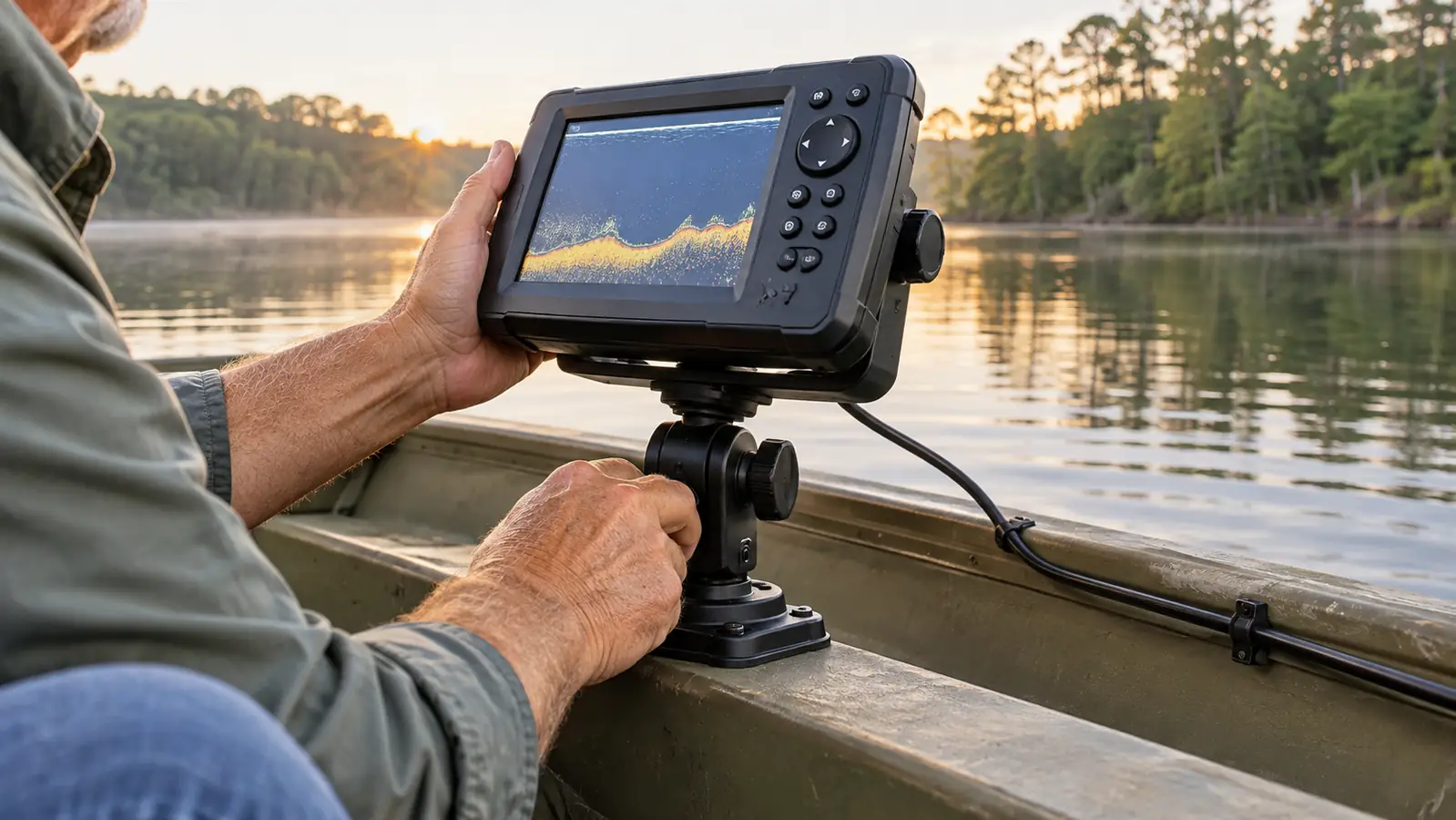
The biggest thing is that it is a complete unit. The display is built into the housing at 3.5 inches diagonal, which works out to roughly 1.9 by 2.9 inches of actual glass, and it sits in the tilt and swivel mount right where I can see it while I am working a jig. There is no phone to dig out of a pocket, no app to wait on, no battery percentage to worry about halfway through the morning. The whole thing weighs 8 ounces and measures about 3.6 by 1.6 by 5.9 inches, so on a small boat it disappears next to the seat and never gets in the way of a rod.
The sonar is the other half of the argument. CHIRP gives me a clean read on fish, and ClearVü scanning sonar shows what is in the water around the boat in a way that plain down-looking sonar never did for me. On a lake with flooded timber, that is the difference between seeing a mark and knowing whether it is a fish sitting next to a branch or just another branch. I spent most of one summer learning to read that screen, and it keeps paying me back in fish I would have driven right past.
The waypoint map is the part I did not expect to lean on. I mark brush piles, stumps and dock corners as I find them, then navigate back to the same spot next spring without hunting for it. The depth rating runs out to 1,600 feet, which is a number I will never touch on a Michigan inland lake, but the GPS side of the unit I use on every single trip.
Where the Deeper Start Wins
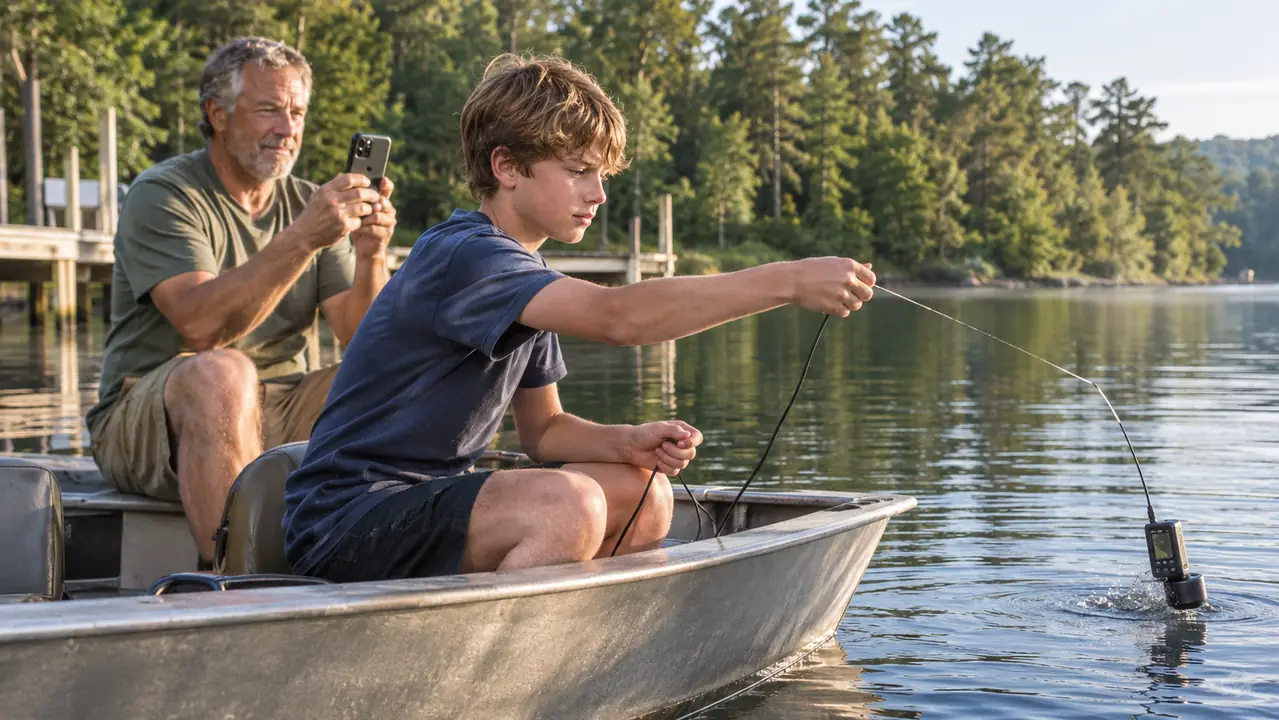
Reach. That is the whole case and it is a good one. The Deeper Start goes where you throw it. I cast it past the weed edge, under a dock, along the shadow line of a pier, and it reads what is actually there. Standing out on the South Haven pier in the fall, that is not a small thing. It is the only way to see what is under the water twenty or thirty yards out, short of swimming it. The Striker 4 cannot help you there, because the transducer stays bolted to the boat.
The second advantage is that there is nothing to install. No transducer bracket, no cable run down the gunwale, no power lead to the boat battery. It rides in the tackle bag next to the pliers and comes out when you want it. On a borrowed boat, a canoe, or a rented skiff, that is the difference between having sonar and not having it at all. A phone screen is also bigger than a 3.5 inch display, which matters more every year my eyes get older, and Tyler can throw the unit himself without me worrying he will foul the cable on a stump.
The Garmin showed me a flat that ran nine feet deep for a hundred yards. The Deeper showed me a stump pile eight feet past the end of a dock I had been casting at for two years.
Two Trips That Settled It for Me
The first was a July morning on a ninety-acre lake with the jon boat. I ran the Garmin the whole time, marked four brush piles and a stump field on the waypoint map, then came back to two of them in the afternoon and caught fish off both. There is no version of that day where a castable unit does the same job, because I needed to cover water, remember where I had been, and come back to it after lunch.
The second was a short evening off the end of a public dock with no boat involved. I tied the Deeper Start on, threw it out past the sand break, and watched the bottom drop from about three feet to eleven in two casts. There was a stump pile sitting off the end of that dock that I had fished past for years without knowing it existed. The Garmin could not have told me that. It was sitting in the truck a quarter mile away.
That is the whole comparison in two days. One tool makes a boat smarter. The other makes the bank fishable. If you do both kinds of fishing, you will eventually want both, and if you can only buy one, the real question is which kind of fishing you actually do most weekends.
What I Liked
- Display is built into the unit, so nothing depends on a phone staying charged
- ClearVü scanning sonar and CHIRP separate fish from cover
- Waypoint map for marking and returning to brush piles, stumps and docks
- Tilt and swivel mount plus a keyed interface with dedicated buttons
- 1-year limited warranty from Garmin
Where It Falls Short
- Transducer mounts at the transom, so it reads water behind the boat
- Wiring the power and cable run is real work on a bare aluminum hull
- A 3.5 inch screen is small if your eyes are not what they used to be
- Cannot reach water the boat cannot get to
The Numbers That Actually Change How You Fish
Lay the spec sheets side by side and most of it is noise. The number that matters on the Garmin is the display size: 3.5 inches diagonal. That sounds tiny in a catalog until you are standing in a boat and the screen is a foot from your face on a swivel mount. The depth rating of 1,600 feet is honest and I will tell you straight that it is irrelevant where I fish. Nothing in Kalamazoo County is close to that. It is there for the saltwater crowd, and it costs you nothing to ignore.
The number that matters on the Deeper is reach, not depth. A castable unit is limited by your arm and your line, and that is fine, because the entire point is water you cannot get to from the boat. What you give up is the map. There is no waypoint screen to mark a brush pile and come back to it next spring, so if you find something good you had better write it down or drop a marker buoy. That is the feature I miss most when I am running the Deeper.
Weight and footprint matter on a small hull. The Striker 4 is 8 ounces and about 3.6 by 1.6 by 5.9 inches, so it does not crowd a 14-foot boat with two people and a cooler in it. Both of these units fit in a small boat without a fight, which is more than I can say for the big console units the bass guys run.
What Bugs Me About Both
On the Garmin, the install is the price of admission. You are running a cable from the transom forward, finding a home for the mount, and getting power to the unit. On a bare aluminum boat that means clamping or drilling and then living with the cable run for as long as you own the boat. And because the transducer is at the back, everything you see is a little behind you. That is not a defect, it is just how transom sonar works, and on a slow drift it hardly matters.
On the Deeper, the phone is the weak link. A phone in full sun with the brightness up drains fast, and the glare coming off the water is worse than the glare off a dedicated display. You are also holding it, so you are not holding the rod with both hands when a fish hits. Tyler lost interest in the phone screen faster than he lost interest in the boat screen, which tells you something about which one holds a kid's attention on a slow morning.
What Neither One Will Do for You
Neither of these will make fish bite. I have marked a pile of crappie on the Garmin, dropped a jig on their noses, and gotten nothing back but a snag and a wet sleeve. Sonar tells you where the fish are sitting. It does not tell you what they want that morning, and it will not turn a lure the fish are ignoring into one they will eat.
Neither one replaces knowing the lake, either. The fish slide shallow in the spring and drop off the edges in July, and no screen changes that. The electronics shorten the search and save you from fishing dead water. They do not do the fishing. That is the honest version, and it is what I would say to anybody at the counter before they pull out a wallet.
If you fish from your own boat, this is the one that earns its spot
The Garmin Striker 4 with transducer: CHIRP and ClearVü sonar, waypoint map for marking brush piles and stumps, 3.5 inch display on a tilt and swivel mount. Check today's price on Amazon.
Amazon Check the Garmin Striker 4 on Amazon →Who Should Buy Which
Buy the Garmin Striker 4 if you own the boat you fish from, you trailer it, and you want one screen that shows depth, fish, bottom and a map of the spots you have found. It is the tool for a guy who fishes the same handful of lakes and wants to learn them properly instead of starting over every spring. The waypoint map, the ClearVü sonar and the built-in display all reward time on the water, and the unit is out of your way the rest of the time.
Buy the Deeper Start if your fishing is bank, dock, pier, or a boat that belongs to somebody else, and you want to see what is under the water in front of you before you make another cast into nothing. It is also the easier first unit for a kid, since there is nothing to install and nothing to break except a phone you already own. If you fish both ways, and a lot of us do, keep the Garmin bolted to the boat and put the Deeper in the bag for the days the boat stays home.
Buy the one that matches where you actually stand
Boat and trailer, go with the Garmin Striker 4. Bank, dock or borrowed boat, go with the Deeper. The Striker 4 listing is right here.
Amazon See the Garmin Striker 4 on Amazon →