

The first fish finder I ever ran was a hand-me-down with a screen the size of a postage stamp and a transducer cable that had been spliced twice with electrical tape. It worked about as often as it did not. I kept it for eleven years because I figured that was just what a fish finder was: a gadget that told you the depth when it felt like it and went dark the one morning you actually needed it.
I retired from the machine shop in 2019 and started fishing seriously again, mostly the small inland lakes west of Kalamazoo. One 14-foot aluminum jon boat, a trolling motor, and me. My grandson Tyler rides along on summer weekends. He asked me one morning why the old screen kept flickering, and I did not have an answer worth giving a 12-year-old. So I ordered the Garmin Striker 4, mainly because a retired machinist trusts buttons more than menus.
Here is what I was doing before. I fished structure I could see: the dock pilings, the weed edge, the one stump field on the north end of the lake. Everything else was guesswork. I would drag a jig through open water and tell myself the fish were down there somewhere. Some days they were. Most days I was fishing the water I could imagine instead of the water that actually held fish, and there is a real difference between those two things.
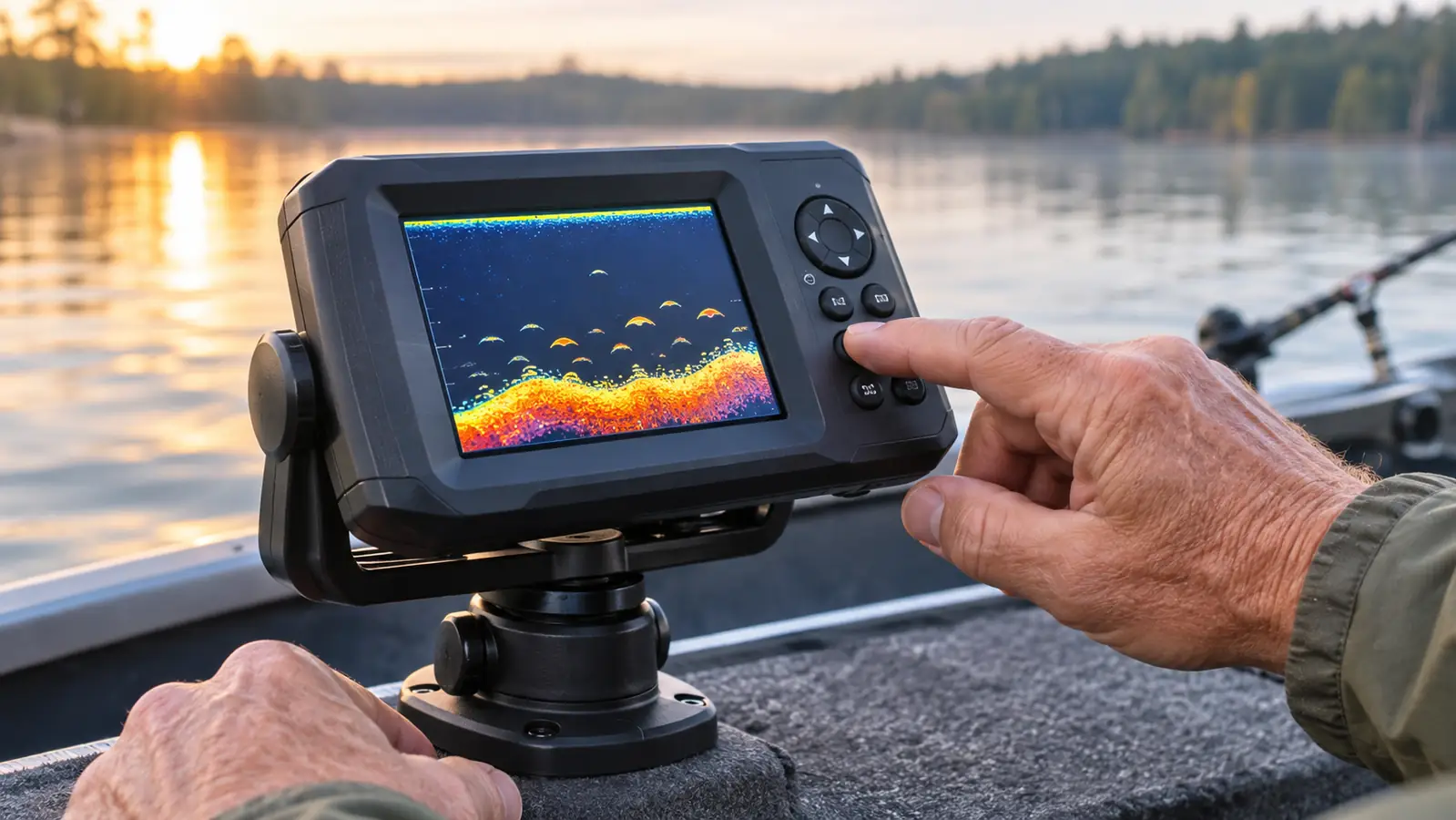
The Striker 4 went on the boat in about the time it takes to drink a cup of coffee. The tilt and swivel mount screws to the deck, the transducer clamps to the transom, and the power cable runs to the battery. There is no touchscreen and nothing to swipe. It has dedicated buttons and a keyed interface, which means my wet thumb hits the one I meant even with the boat rocking and Tyler asking questions.
First trip out, the thing that changed my fishing was not the depth number. It was seeing the bottom as a shape. A brush pile I had been fishing for years turned out to be three separate piles, and the fish were holding on the second one. I marked it with the waypoint map, came back the following weekend, and fished it again from the saved spot. It produced. That is the whole return right there, in one June morning.
Two of the three brush piles I had been fishing for years did not exist on the screen. The third one held every crappie I caught that June.
See what the bottom of your lake actually looks like
Same unit I run on the jon boat: 3.5 inch display, dedicated buttons, CHIRP sonar and a waypoint map for the spots worth coming back to. Check today's price and the current listing on Amazon.
Amazon Check Today's Price on Amazon →The waypoint map is the part I did not expect to use. I am not a GPS guy by nature. But when you find a stump line that holds bass in July, you want to come back to that stump line in August, and I cannot hold a shoreline in my head the way I could at forty. Press the button, save the spot, navigate back to it. Tyler learned the map in one afternoon, which is faster than I learned it, and he now considers himself the navigator.

Power is battery, so there is no outlet to hunt for and no cord running back to the house. The unit itself weighs eight ounces, so mounting it did not cost me any space on a 14-foot boat where space is already tight. It comes with the transducer and the mounting hardware in the box, which meant I did not spend a Saturday ordering the one bracket I forgot.
Now the trade-offs, because I would rather tell you them now than have you find out on the water. The screen is 3.5 inches diagonal, which works out to 1.9 by 2.9 inches of actual glass. In flat morning light it is perfectly readable. At noon in July with the sun over your shoulder, I lean in. That is the honest answer. If you want a big screen, you buy a big screen and you find room for it. This is not that.
It also does not do everything. You get the scanning sonar, the depth reading and the waypoint map. You do not get side imaging, and I am not going to pretend this thing turns the water into a photograph. What it does is show me where the bottom changes and where fish are sitting relative to that change, and on the lakes I fish those two pieces of information cover most of the decisions I make in a day.
I have also run it off the pier at South Haven a few springs, the unit pulled off the swivel mount and the transducer aimed straight down past the end. Different water, same job: read the drop-off, stop casting into nothing. My back does not miss the old routine of guessing where the break was and losing a jig to find out.
What I'd Tell You If We Were Sitting at My Kitchen Table
I would tell you that most of the fishing I do does not need a screen at all, and that no fish finder will catch a fish for you. It shows you the water. You still have to make the cast and you still have to work the lure. What the Garmin Striker 4 did for me was stop the guessing. I stopped fishing empty water. I stopped wondering whether the drop-off was three feet out or thirty. It is a small, plain, button-driven tool with a one-year limited warranty, and for a guy on a jon boat with a trolling motor and a retired man's patience, that is enough. If Tyler is still asking to come along at fifteen, I will count that as the real measure of the thing.
Stop guessing where the drop-off is
The Garmin Striker 4 with transducer: 3.5 inch LCD, keyed interface with dedicated buttons, CHIRP sonar, waypoint map, rated to 1,600 feet of depth. Check today's price on Amazon before your next morning on the water.
Amazon Check Today's Price on Amazon →