

The first thing that broke on my old pair of fishing pliers was the spring. Not the jaws, not the cutters. The spring let go somewhere in the bottom of my jon boat on a small lake west of Kalamazoo and left me squeezing two handles together like a man trying to start a fire with wet wood. I went through two cheap pairs that summer and both of them died the same way. Then in April I bought the Booms Fishing X1, and I fished it without a backup for a full season to see whether it would do the same thing.
What follows is not a lab report and it is not a sponsored write-up. It is a season of notes from a 61-year-old retired machinist who fishes small inland lakes for bass, bluegill and crappie, a nearby river for smallmouth, and the piers at South Haven when the fall run comes through. Fresh water the whole way, even though these pliers are built for salt. Here is what held up, what did not, and who they actually suit.
The Quick Verdict
Light aluminum handles, a spring that stays where it belongs, and a small hook at the jaw tip that earns its keep on split rings. The sheath is the weak link, not the tool.
Amazon Check Today's Price →Buy it for the spring. Keep it for the hook at the jaw tip.
Aluminum handles, stainless steel jaws, inset spring, and cutters built into the handle. Rated 4.6 across 2,846 reviews on Amazon.
Amazon Check Today's Price on Amazon →How I've Used It
My season starts with crappie, usually the second week of April, sitting still over brush in about eight feet of water with a slip bobber and a minnow. That is not glamorous fishing and it is not glamorous plier work either. Crappie take a small hook deep, and I was unhooking fish every few minutes with cold hands, a wet net, and a hook buried past the barb more often than I would like to admit. A slim jaw helps there. So does being able to see what you are doing without your fingers in the way.
May is the river, smallmouth, and crankbaits. Crankbait season for me means split rings, because I swap hooks more than a reasonable man should. June through August is bluegill and the occasional largemouth with my grandson Tyler, who is twelve and who decorates the trees behind him with more tackle than he puts in the water. Fall is the piers at South Haven, where the wind comes across the lake and everything you are carrying gets wet whether you planned on it or not.
Across seven months the pliers did five jobs: unhooking fish, cutting line, opening split rings, crimping split shot, and once prying a hook out of a boat seat that had nothing to do with fishing. They rode on my vest in the sheath, or hung off the coiled lanyard while I switched lures every few casts. They were never oiled. They were never rinsed at the end of the day. They still open and close on their own spring, which is more than I can say for anything I owned before them.
One morning in late May sticks with me. I was on the river north of Three Rivers, water up and off color from two days of rain, throwing a squarebill along a fallen sycamore. I hung it on the second cast and had to back the boat off the log, retie, and go again. By nine o'clock I had retied four times, popped a hook out of a fourteen-inch smallmouth, and opened a split ring to swap to a different color. That is three of the five jobs in under an hour, and I never took the pliers off the lanyard once. With the old pair I would have been digging around the bottom of the box for the clippers somewhere in the middle of that, and the fish would have been out of the net and gone before I found them.
The other thing I did, and I would recommend it, is I left the backup pair at home. If you carry a spare you never learn anything about the first one. The X1 was the only plier in the boat from April through October, and every time I needed to cut a tag end or pop a hook out of a bluegill in the net, this was the tool I reached for.
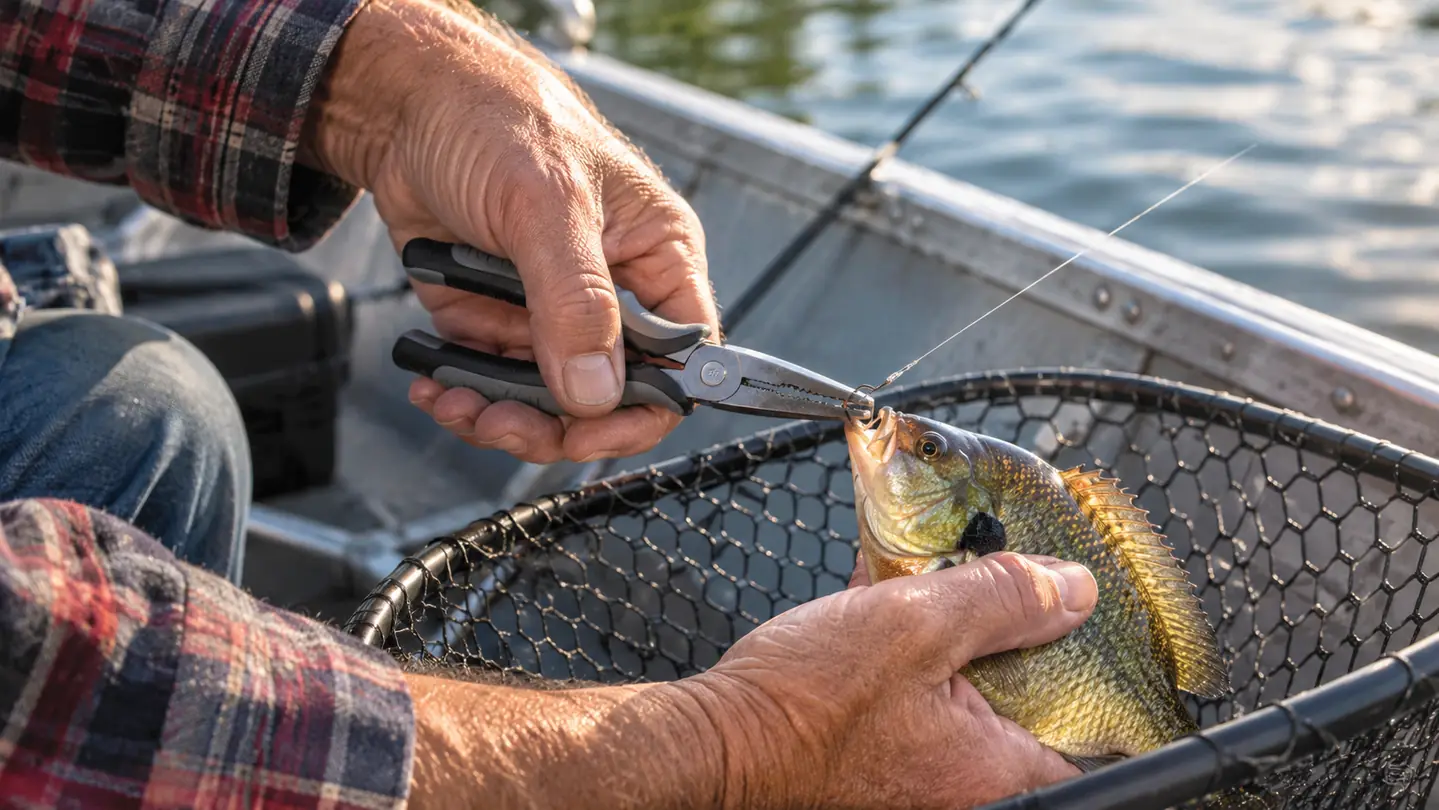
The Hook at the Jaw Tip Is the Reason to Buy These
Most pliers claim they open split rings. In practice the tip is too fat, or too blunt, and you end up with a treble in your thumb and a crankbait skittering across the floor of the boat. The X1 puts a small hook at the top of the jaws, and that hook catches the ring and rolls it open instead of fighting it. I swapped three treble hooks on a lipless crank in about four minutes on the water, which for a man with reading glasses and cold fingers is quick.
The first time I tried it I did not trust it. I had a lipless crank with a rear treble that had bent out on a rock, and the old pliers would have had me pinching and prying until the ring looked like a pretzel. The X1 caught the ring on the first attempt, rolled it back, and the hook came off clean. I put the replacement on the same way and the ring closed back flat. A split ring that gets bent stays weak, and a weak ring is where you lose a good lure and a good fish in the same cast. Fewer bent rings is not a small thing over a season. I figure I opened somewhere around forty of them between May and October, and I did not throw away a single ring because it was mangled.
The same hook earns its keep on fish. It reaches in past the curve of a hook shank and backs the point out, and the slim jaw profile gets in without chewing up the fish. On bluegill you are usually doing this with the fish still in the net and one hand holding the line, so anything that saves a step saves time. Booms Fishing lists hook removal and split ring opening as the specific jobs, and that matches what the tool does in the hand rather than just on the package.
The jaws are stainless steel and the handles are aluminum. The whole thing is built like a small pair of side cutters, and there is no flex in the jaw under a hard squeeze. That is the difference between a tool and a toy. When you are working a hook out of a bass with a jaw like a rock, or pinching down a split shot that has already been squeezed twice, you want the jaw to be the stiffest part of the equation.
The Cutters and the Spring, Where Cheap Pliers Die
The cutters are inset into the aluminum handle, and Booms Fishing says the aluminum is what allows that, since the handle is light enough to hold the cutter inserts without turning the tool into a brick. What I can tell you from the water is this: 20 lb braid cuts clean in one squeeze, right at the tag end, with no fray and no fuzz. 50 lb braid on the heavy rod took two squeezes the first time and one after the jaws wore in. 12 lb mono is not even a conversation.
Cutting braid on a windy pier is the real test, and I did plenty of it in October at South Haven. Braid does not cut like mono. It wants to slide out of the jaws, and dull cutters will chew it into a fuzzy tag that will not go through a guide to save your life. I re-rigged a steelhead setup four times in one afternoon in a crosswind with these, and every tag end came off square enough to thread on the first try. The cut is clean enough that I stopped carrying a separate set of clippers in my jacket pocket, which I had done for years. That is the difference between a cutter that is actually inset and sharp and the stamped notch a lot of cheap pliers call a cutter.
The inset spring is the part I care about most, because it is the part that failed on everything I owned before this. It sits inside the handle rather than riding on a pin at the hinge, where it can walk off. Seven months in, it still snaps the jaws open on its own, and I have not had to pull the handles apart to reseat it once. With the last pair I was doing that twice a season, usually on the water, usually with a fish flopping in the net.
Here is the trade-off, and it is worth saying out loud because nobody else will. A spring inside the handle is a spring you cannot see. When it eventually goes, you will find out mid-unhook, the same way I did with the old pair. It is not serviceable on the water and there is no field fix for it. Carry a spare on anything longer than a day trip. That is true of every sprung plier on the market, not just this one.

Weight, Grip, and How It Carries
The spec sheet lists 0.19 kg, and that is light enough that I forget it is on my belt until I need it. The grip is smooth aluminum with no rubber overmold. On a dry day that is fine, and it wipes clean in a second, which rubber does not. With wet hands and fish slime on them, smooth aluminum is slick. I fumbled it once over the side while unhooking a decent smallmouth and the coiled lanyard was the only reason I still own these pliers. That lanyard is not a marketing extra. It is the reason the tool is still in my boat.
Cold mornings are the other thing nobody mentions. In April the temperature at the launch is often in the thirties, and aluminum at thirty-five degrees is a handle you feel in your knuckles. I wore fingerless wool gloves for the first three weeks of the crappie season and the pliers were still cold enough that I handled them in short bursts and put them back on the lanyard. That is not a knock on the tool, since every metal plier on earth does the same thing, but it is the reason I keep these hanging where I can reach them with two fingers instead of digging in a pocket. A tool that is easy to reach is a tool you actually use, and the one you leave in the box is the one that rusts.
The sheath is the weakest part of the package. It holds the pliers, and the belt loop has not torn, but it is not a stiff sheath, and after a season of being wet and being sat on in an aluminum boat the mouth has softened up. The lanyard coil has held up better than I expected and the clip is still tight. If Booms Fishing upgraded one component, that is the one I would pick.
What I Liked
- The hook at the jaw tip opens stubborn split rings in seconds instead of minutes
- The inset spring still snaps the jaws open after seven months, with no reseating
- Cuts 20 lb braid clean in a single squeeze
- 0.19 kg, light enough to forget it is on your belt
- The coiled lanyard already saved it once over the side
Where It Falls Short
- The sheath softens up over a season
- Smooth aluminum grip is slick with wet, slimy hands
- The spring is not serviceable on the water
- 50 lb braid sometimes needs a second squeeze
Seven months, two line types, one pair of pliers, and the spring is still where it belongs.
Who This Is For
These are for the angler who wants one tool in the vest instead of three. If you fish plastics and crankbaits, if you re-tie often, if you swap hooks on the water, you will use every function on this thing in a single morning. It is rated 4.6 across 2,846 reviews on Amazon, and after a season I understand why that number is high without being perfect. The people who like it are the people who actually use the split ring hook instead of just admiring it.
It is also a reasonable first pair for a kid or a beginner, because the spring holds the jaws open for you and the hook at the tip means fewer bent trebles and fewer cut fingers. Tyler used them more than once when his own clippers went into the lake. I did not worry about him breaking them, which is not something I could have said about the cheap pair they replaced.
Who Should Skip It
If all you ever do is cut line, skip these. A pair of line clippers on a retractor weighs almost nothing and costs less, and a multitool is only worth carrying if you use more than one function on it. Be honest with yourself about that. Most of the fishing I do needs a hook remover and a split ring opener, which is why these live on my vest, but a lot of anglers never open a split ring in a whole season.
If you want a bench-quality crimper for heavy leader sleeves, this is not that tool. The crimp works on split shot and light work, which is what I use it for. It is a fishing plier that crimps, not a crimping tool that also fishes. And if you cannot abide rinsing and oiling a tool now and then, buy the cheapest thing on the rack and treat it as disposable, because even a good pair of pliers in salt water wants some attention.
One pair, five jobs, a full season in the boat.
Aluminum handles, stainless steel jaws, inset spring, braided line cutters, coiled lanyard and sheath. The sheath is the only part I would change.
Amazon Check Today's Price on Amazon →