
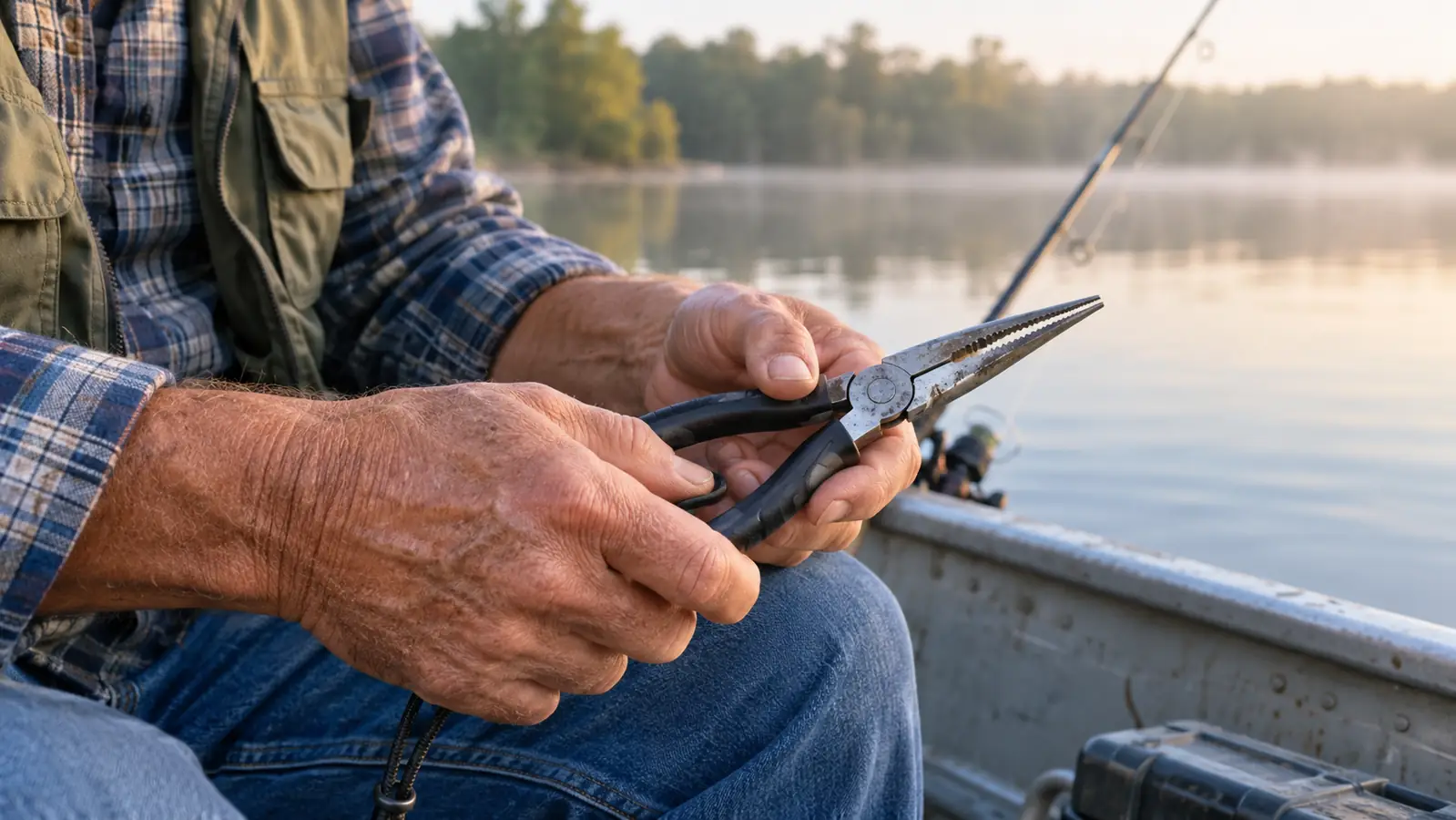
Short answer first, because that is what I wanted when I was squinting at listings at my kitchen table with a cup of coffee going cold: if you tie braid and open split rings more than once a trip, the Booms Fishing X1 is the pair I would hand you. If you deep-hook bigger fish and want a nose that reaches past the last hook guide, the KastKing Cutthroat earns its spot on the belt. I have fished both, and one of them has been hanging off my belt loop for two full seasons.
For context on who is doing the comparing: I am 61, a retired machinist, and I fish the small inland lakes around Kalamazoo for bass, bluegill and crappie, the nearby river for smallmouth, and the Lake Michigan piers at South Haven when the fall run comes through. Most trips are out of a 14-foot aluminum jon boat with a trolling motor on the back, and the rest are from shore or a pier. My grandson Tyler, 12, comes along on some summer weekends and loses more hooks than he sets. That is the test bed. Nothing below came off a tournament boat or a sponsor's table, and nobody gave me either pair to review.
| Booms Fishing X1 | KastKing Cutthroat | |
|---|---|---|
| Opening a stubborn split ring | A small hook forged at the top of the jaws slips under the ring and pops it, no thumbnail involved | Flat jaw tip, so you wedge the tip in and work the ring around by feel |
| Cutting braid | Cutters are inset into the aluminum handle, so the line goes in near your palm and one squeeze ends it | Cutter sits up near the jaw pivot; it cuts clean, but you feed the line deeper into the notch |
| Reach on a deep hook | Short jaws mean a swallowed hook usually becomes a fingers job | Longer nose gets past the last hook guide without putting your hand down a fish's throat |
| Grip with wet, bait-covered hands | Smooth aluminum handles, easy to wipe down and a little slick when your fingers are messy | Textured handles hold better when everything on the boat is wet |
| Weight on the belt | 0.19 kg with the sheath and coiled lanyard, light enough to forget it is there | Carries noticeably heavier in a vest pocket than the X1 does |
| Staying attached over the water | Coiled lanyard comes in the box and stretches far enough to land a fish without unclipping | Mine hangs on a tether I added myself |
| Crimping a split shot or sleeve | Jaws close flat enough to crimp a shot | Same job, done the same way |
| Best for | An angler who ties braid and opens split rings all day | An angler who deep-hooks bigger fish and wants reach |
How I Compared Them
I have run the Booms Fishing X1 for two seasons. I borrowed a KastKing Cutthroat for three weeks in September and again for a stretch this spring, which is long enough to form an opinion and short enough that I will not pretend it is a lifetime test. I judge a pliers on four jobs: getting a hook out of a fish without tearing it up, opening a split ring to swap a treble, cutting braid clean, and surviving a boat floor that is never quite dry. Everything else is decoration.
The X1 is aluminum-handled with stainless steel jaws and matching small parts, and the listing puts the whole thing at 0.19 kg with the sheath and coiled lanyard. Those are the numbers I can check and repeat. What I cannot check is the saltwater claim in the title, because Lake Michigan is fresh water. I have never put either pair in the surf, so treat that rating as a spec from the manufacturer, not as a promise from me.
One more thing before we get into it. I am left-handed, and by eight in the morning my hands are wet with lake water and bait. A pliers that takes two hands to open is a pliers I will fumble. That bias runs through everything below, so weigh it however you like.
The Jaws: Opening Split Rings vs Reaching Deep Hooks
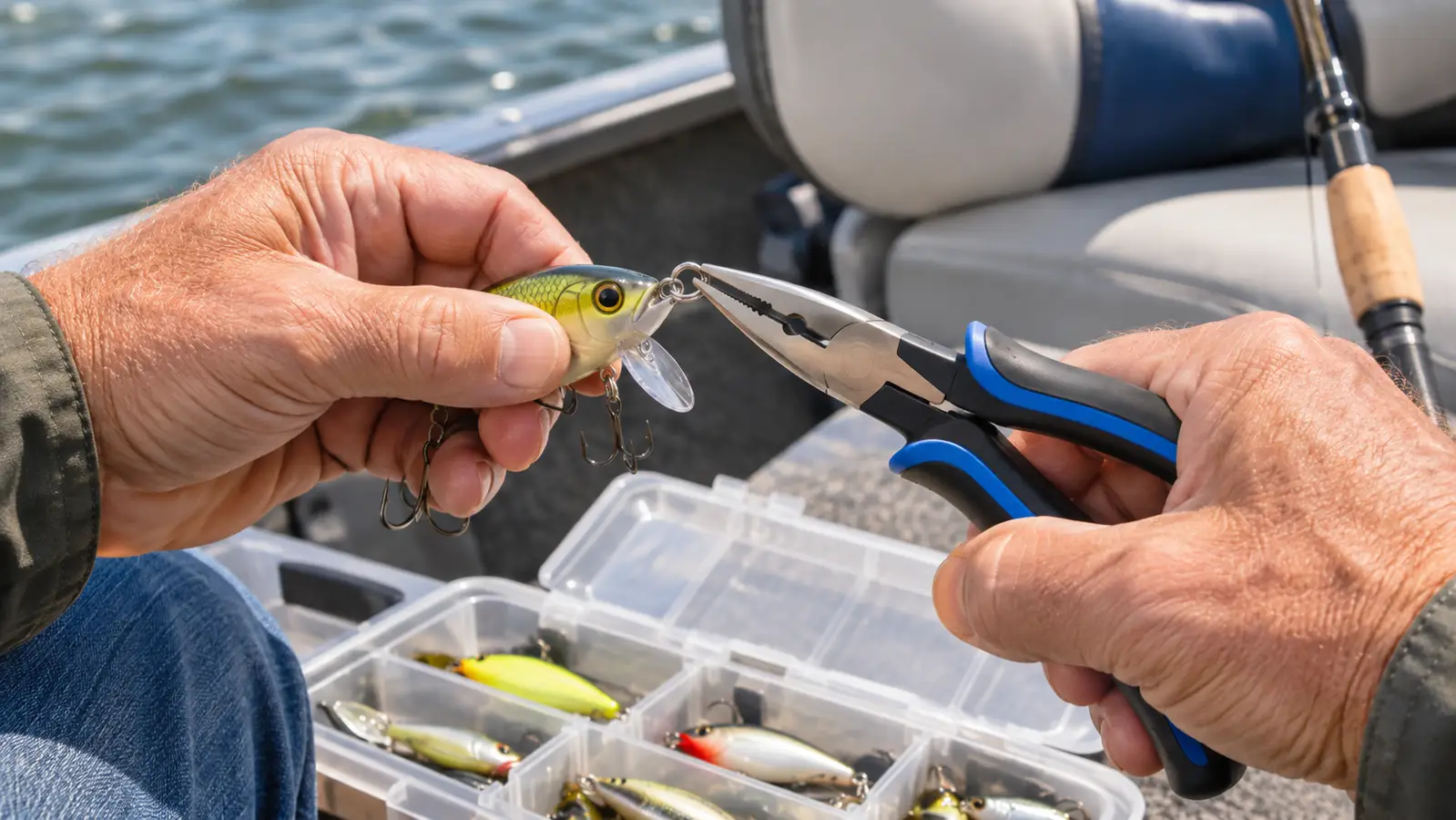
The feature that sold me on the X1 is a small hook forged at the top of the jaws. It is not glamorous, and it does exactly one job: it slips under a stubborn split ring and pops it open. That means I am not digging at a treble hook with a thumbnail while a bass flops on the boat floor. I swap trebles on crankbaits more than a reasonable man should, and that little hook has saved me a dozen small headaches and one very sore thumb.
The trade-off is length. The X1's jaws are short, and short jaws are honest jaws. On a bluegill or crappie that has swallowed a hook past the lip, I can see the hook, I just cannot reach it with the pliers. That becomes a fingers job and I do it. One morning last June I proved that to myself the hard way. A crappie took a jig down past the lip in about eight feet of water off a dock, and I stood there with the X1 in my hand and nothing to grab. I laid the fish on the boat seat, worked the hook free with my fingers, and put it back in the water it came out of. No harm done, but it cost me a couple of minutes and a bait, and I knew the whole time that a longer nose would have had that hook out in seconds.
The Cutthroat has a longer nose, and on a river smallmouth that took a tube deep, that reach did real work. It got to the hook without me putting my hand down a fish's throat, and the fish went back in the water faster because of it.
The Cutters: Where Braid Actually Gets Cut
The X1 sets its cutters into the aluminum handle rather than out at the jaw pivot. I did not think that would matter. It does, at least for my hands. When I have a fish in one hand and a lure in the other and I want to snip a tag end of braid, the line goes into a notch near my palm, I squeeze, and it is done. The listing says the cutters take braided and mono line, and mine has, including 30 lb braid that would make nail clippers whimper.
I keep a cheap pair of nail clippers in the same pocket as a backup, and I have not touched them since the first week with the X1. That is the simplest measure I can give you. When I trimmed a tag end of 30 lb braid after tying a leader on the river in April, one squeeze went through it clean, and I did not have to look down to find the notch.
The Cutthroat's cutter sits up closer to the pivot. It cuts, and it is not dull. But I had to feed the line deeper into the notch and pay attention to which side of the blade I was on. In good light on a calm morning that is nothing at all. On a rocking pier with a smallmouth doing its best to leave, I noticed it. If you cut braid ten times a trip, where the cutter lives matters more than a fraction of sharpness.
Handles, Springs and Wet Hands
The X1 has smooth aluminum handles with a spring inset into the handle, so it opens on its own and closes with one hand. Smooth is the word, and it cuts both ways. It wipes clean easily and does not hold lake slime. It is also slick when your fingers are covered in bait. I have bobbled mine once and caught it on the lanyard, which is the reason I keep the lanyard on even when I am just moving between spots.
The Cutthroat's handles are textured, and I will say plainly that the texture is better with wet hands. That is a row where the other pair wins and I am not going to dress it up. The spring in the pair I borrowed also felt firmer, which I liked for one-handed opening and disliked when I was holding it closed over a hook. Firm is a preference, not a fact, so take that for what it is worth.
Two Seasons in a Wet Boat
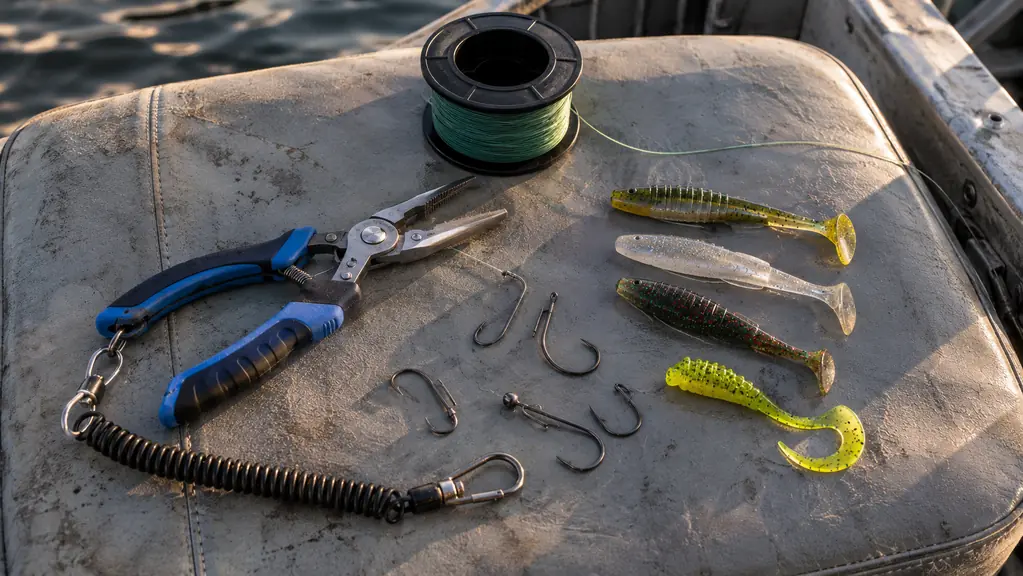
You can tell a lot about a fishing tool by what it looks like after a season in a boat that never quite dries out. Mine lives in the tool pocket beside a spool of line and a rag. After two seasons of that, the jaws on the X1 are stained but sound, the cutters still bite, and the spring still does its job. The aluminum has a few scuffs from the bottom of the pocket, which is what happens to anything you actually use instead of admire.
I also want to be straight about one cosmetic thing. The finish on the aluminum handle has worn thin at the corner where it rubs against the sheath, and after two seasons there is a bright spot about the size of a pencil eraser. It affects nothing. It is just what a working tool looks like when it works, and I would rather see that than a pliers that sat in a drawer.
Care is not complicated and it is not optional. I rinse both pairs in fresh water at the end of a trip, dry them on the ride home, and put a drop of oil on the pivot about once a month. That routine is why neither pair has rusted on me. If you throw a pliers in a wet box and leave it until next Saturday, no listing on any website will save it, and that goes double if you fish salt.
Where the Booms Fishing X1 Wins
The X1 wins the two jobs I do most: opening split rings and cutting braid. The hook at the top of the jaws is a useful piece of design rather than a bullet point on a listing, and the inset cutters mean my cutting happens in the same motion as my grip. Put together, those two things make it the faster pliers for tackle changes, and I change tackle constantly, whether the fish are cooperating or not.
It also wins on weight and on what comes in the box. At 0.19 kg with the sheath and coiled lanyard, it disappears on a belt loop, and the lanyard is long enough that I can land a fish with the pliers still clipped to me and never think about dropping them over the side. Light and attached is a dull combination to write about and a fine one to fish with. That is why mine has not gone into the lake in two seasons.
The Pair That Opens the Ring and Cuts the Braid in One Motion
Aluminum handle, stainless steel jaws, a hook at the top of the jaws for stubborn split rings, and cutters set where your palm already is. Mine has ridden a belt loop through two seasons of small-lake fishing.
Amazon Check Today's Price on Amazon →Where the KastKing Cutthroat Wins
The Cutthroat wins on reach. A longer nose is not a small thing when a hook is set deep, and fewer fingers in a fish's mouth means a cleaner release and less time with a hook near your knuckle. On the river, throwing tubes and creature baits for smallmouth, I reached for it first every single trip, and I noticed when I gave it back.
It also wins on grip texture, and that is worth more than it sounds. Wet hands, cold morning, fish slime, lake water, and the textured handle holds where the smooth one wants to slide. If you fish from a pier or wade a river where you are never dry, that is a real case. I would take the smooth handle for easy cleanup and the textured one for security, and I would not argue with anybody who chose the other way.
Who Should Buy Which
Buy the Booms Fishing X1 if your day is built around braid and hardware. If you throw crankbaits, swap trebles, tie leaders and open split rings until your thumb complains, the inset cutters and the split ring hook will earn their keep. It is also the pick if you want something light on a belt loop with a lanyard already in the box, or if you fish from a small boat where a dropped tool is a lost tool.
Buy the KastKing Cutthroat if you fish bigger baits and bigger fish and want the reach. River smallmouth, deeper-hooked bass, anything where the hook disappears past the last guide, that longer nose does work short jaws cannot. It is also the better call if your hands are wet all day and you want texture under your fingers more than you want an easy wipe-down.
And if you are new to this and own neither, do not overthink it. Most of the hooks you stick in a fish this summer will be lip hooks, and either pair handles those without drama. Start with the one whose strength matches your fishing, keep it rinsed and oiled, and spend the rest of your budget on line and hooks. The tool matters less than the habit of carrying it.
One last piece of practical advice, and it comes from watching it happen. Whatever you carry, clip it to something. I saw a pliers go over the side of a jon boat exactly once, and it went down without a sound worth hearing. The X1's coiled lanyard solves that out of the box, and a length of paracord on the Cutthroat does the same job.
If Your Day Is Braid and Split Rings, This Is the Pair
Two seasons in a wet tool pocket, cutters still biting, spring still working, lanyard still on the belt loop. The trade-offs are up the page. If they match how you fish, this is the one.
Amazon Check Today's Price on Amazon →