
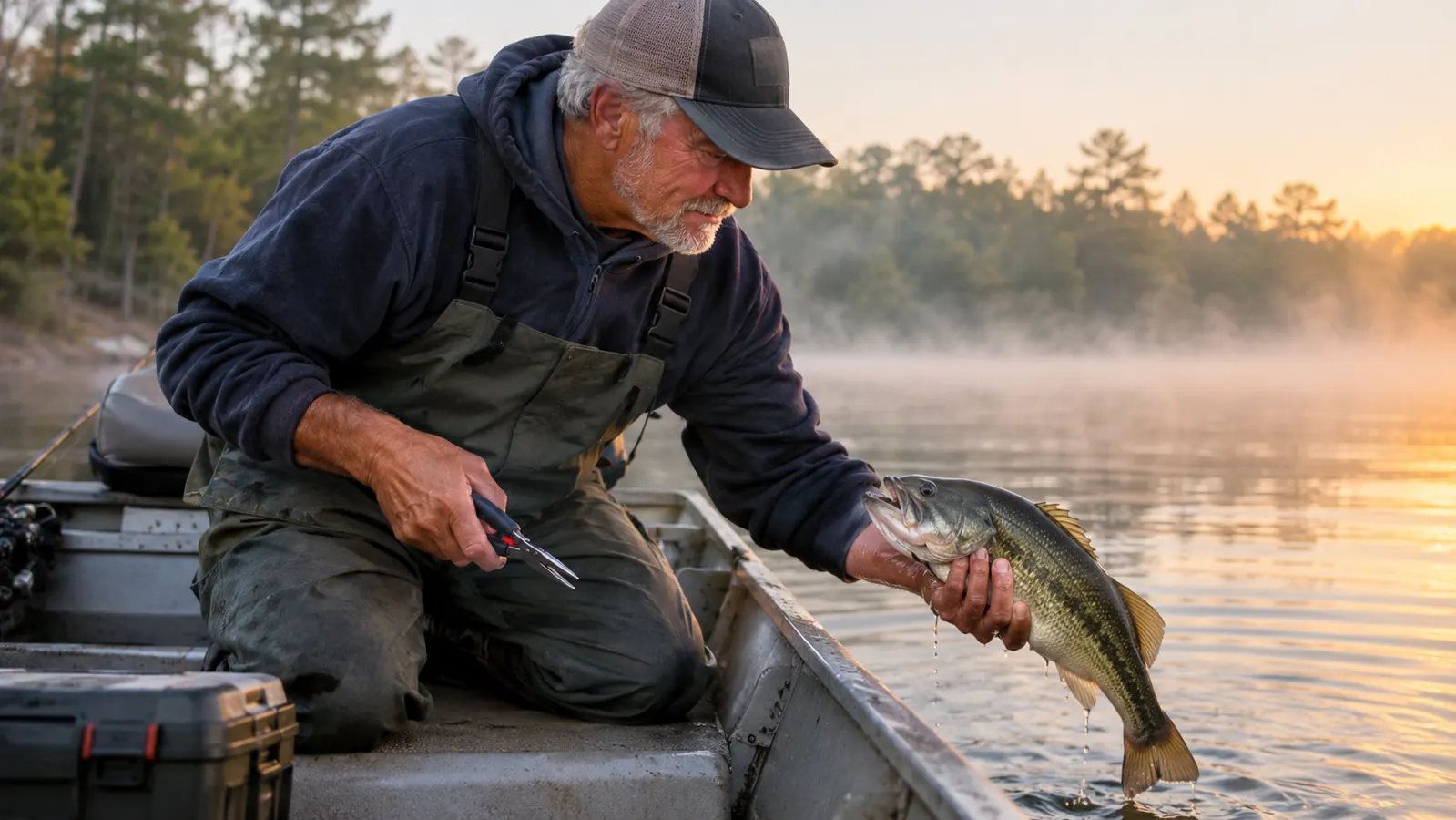
The worst sound on the water is not the splash of a fish coming off. It is the quiet second right after you set the hook, when the fish comes up with its mouth clamped shut and the hook is buried past the barb somewhere your thumbnail cannot reach. I have fished the small lakes around Kalamazoo most of my life, and I have watched more fish get hurt in that first ten seconds than in the whole rest of the fight. Somebody grabs the hook with their fingertips. Somebody squeezes the fish to hold it still. Somebody panics and yanks.
All three of those turn a hook you could have backed out into a hook that has to be cut. And it is a tool problem before it is a technique problem. You are not going to walk a size 2 hook back out of a bass jaw with your fingers, so stop trying before you tear something. My Booms Fishing X1 pliers ride on a coiled lanyard clipped to my vest, and they are what I reach for. Aluminum handles, stainless steel jaws with a small hook at the top for opening stubborn split rings, braided line cutters set into the handle, a sheath for the belt, about 0.19 kg of weight. That weight number matters more than it sounds, because heavy pliers on a lanyard swing around and bang the gunwale every time you lean out over a fish.
The tool that does the job your fingers should not
Booms Fishing X1: stainless steel jaws, aluminum handles, braided line cutters set into the handle, and a coiled lanyard so they stay where you clipped them.
Amazon Check Today's Price on Amazon →Step 1: Settle the fish before you touch the hook
The biggest mistake I see is a person trying to work on a fish that is still flopping in the bottom of a boat. Get it in the net and leave the net in the water. A fish held in a rubber net, still in the lake, is calm enough to work on and it is not slapping itself against bare aluminum while you dig around in its mouth. If your net has knotted nylon mesh, soak the mesh first and keep the fish supported so its weight is not hanging off a few squares of twine.
A morning in late July taught me the rest of it. A three-pound largemouth took a worm down deep off a dock on a small lake west of Kalamazoo, and I lifted it straight out of the net and set it on the bench. Bad idea. The fish came off the bench, and the hook, and my thumb did not. Soak the towel, lay it on the aluminum, and set the fish down on the towel instead of on bare metal. The difference in how long a fish stays still is not subtle.
If the hook is bad enough that you need both hands, lift the fish out and set it on something wet. A soaked towel laid on the boat bench does the job. Wet your own hands first, always. Support the belly on anything bigger than a panfish, and hold a bass by the lower jaw with the fish hanging straight down, not bent off to one side. Never pin a fish against the deck to hold it still. That is how you crack ribs and bruise meat you were planning to eat.
My grandson Tyler has been coming out with me on summer weekends since he was big enough to hold a rod, and the lesson he needed most was the boring one. Slow down. A fish out of water is not on your schedule, and the thirty seconds you spend getting a proper grip is thirty seconds you do not spend later in the emergency room while somebody digs a hook out of your thumb.
Step 2: Find the point before you grab anything
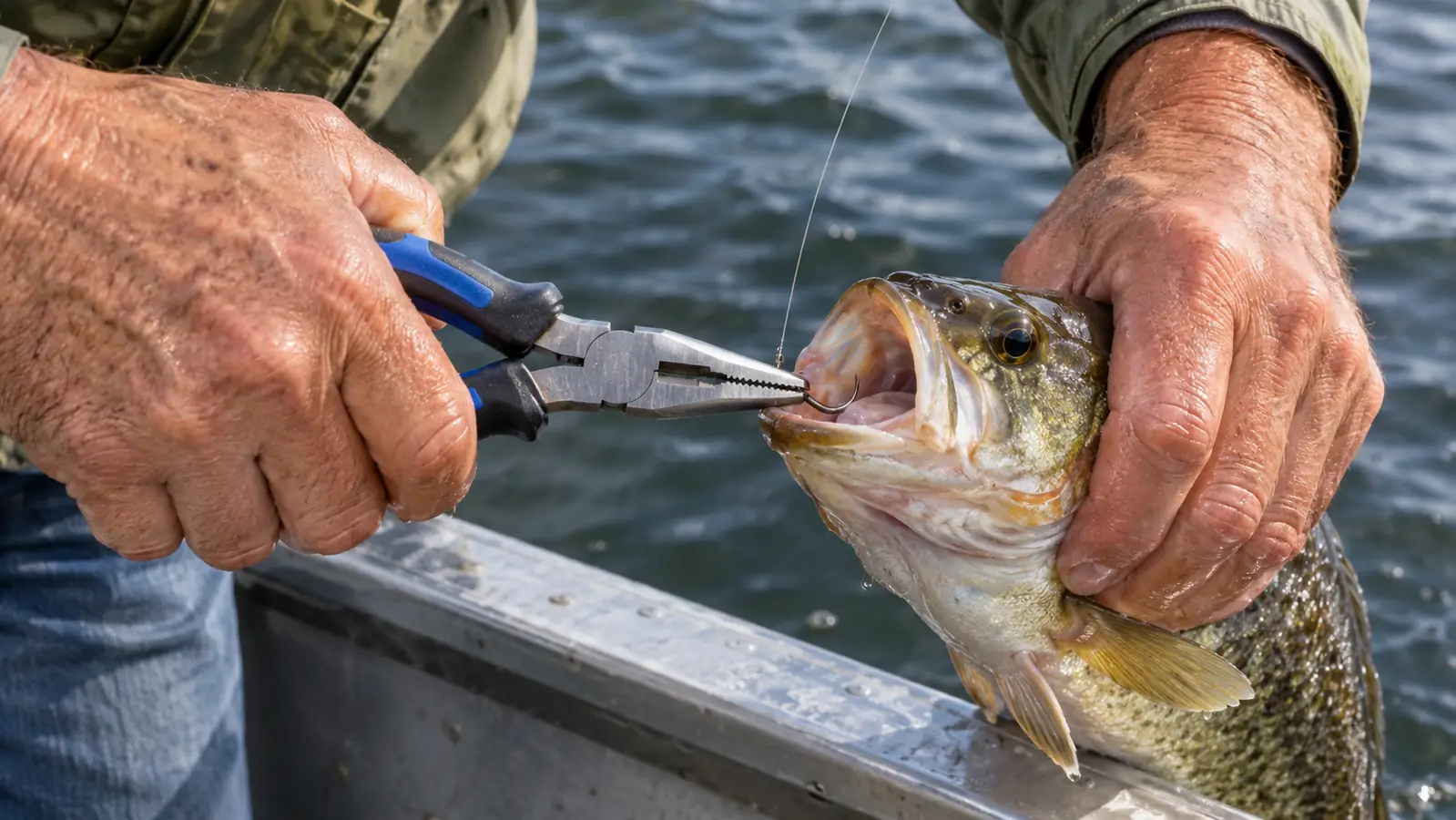
Run the line down to the hook with your eyes, not your fingers. You want to see which way the hook went in and whether the point is tenting the skin on the far side of the jaw. A hook that went in and came back out through the same hole is easy and takes about four seconds. A hook buried past the barb with the point still inside the meat is the one that takes patience.
The angle matters more on a deep hook than a shallow one. When the point is buried, the only thing telling you which way to back it out is the line of the shank going into the mouth, and you cannot see that if your own hand is throwing a shadow across the jaw. On the river I turn the fish so the current is at my back. On the lake I turn it away from the sun. That is the whole trick, and it costs nothing.
Turn the fish so the light is on the hook. On a gray morning on the river that means turning your own body rather than the fish's head, and on a bright afternoon it means putting the sun behind your shoulder. I have stood up in the jon boat more than once just to get the angle right. The fish does not care where you stand. It cares how long it is out of the water.
One thing about the X1 that trips people up: the small hook at the top of the jaws is there for opening stubborn split rings. It is not a probe and it is not a pick. The first time you use it to go digging at a buried point you will push the hook deeper, and you will learn that lesson with a fish in one hand and nobody to blame. Look with your eyes. Use the jaws for the hook.
Step 3: Grip the shank, then back it out the way it went in
Close the jaws on the shank of the hook just behind the eye, or on the bend if the shank is short. Not on the eye itself, because a hard grip on the eye can roll it, and not up near the point, because that is how the point ends up in your knuckle. Get a real grip, then lock your wrist. Loose wrists are what turn a clean removal into a trip to the clinic.
Hook size changes the grip more than most people expect. A size 2 on a plastic worm backs out with almost no effort. A 4/0 wide gap on a flipping bait takes a firmer hand and a bigger opening, and the jaws will not always swallow a heavy wire hook cleanly at the bend. On the heavy ones, grip closer to the eye and spend the extra second finding your angle. Rushing a heavy hook is how you crack a jaw, and that fish does not come back from it.
Then push down and back, following the curve the hook took on the way in. This is the part that takes nerve. Pushing a hook deeper feels wrong and it is exactly right, because you are straightening out the path the barb has to travel. Pulling straight out against the barb is what tears the hole bigger. Down and back, one steady motion, no yanking, no twisting.
The inset spring in the handle opens the jaws back up after every squeeze, so you are not prying them apart with your off hand while a smallmouth is thrashing in the net below you. That sounds like a small thing until the first time you do this alone in a boat with wet hands and cold fingers.
Step 4: Cut the line when the hook is past saving
Some hooks are not coming out. If the hook is down in the gullet or past the gills, and two careful attempts with the jaws have not moved it, stop. Cut the line as close to the hook as you can get and let the hook go with the fish. A hook left in with a short tag of line will usually work loose and pass on its own. A hook that gets ripped around with a pair of pliers will not.
One detail on the cut: leave about an inch of line hanging off the hook, not a long tag. A long tag tangles in weeds and drags, and a fish dragging weeds is a fish burning energy it does not have to spare. An inch is enough slack for the hook to sit loose and work its own way out over a week or two, and it is short enough that it does not catch on anything on the way.
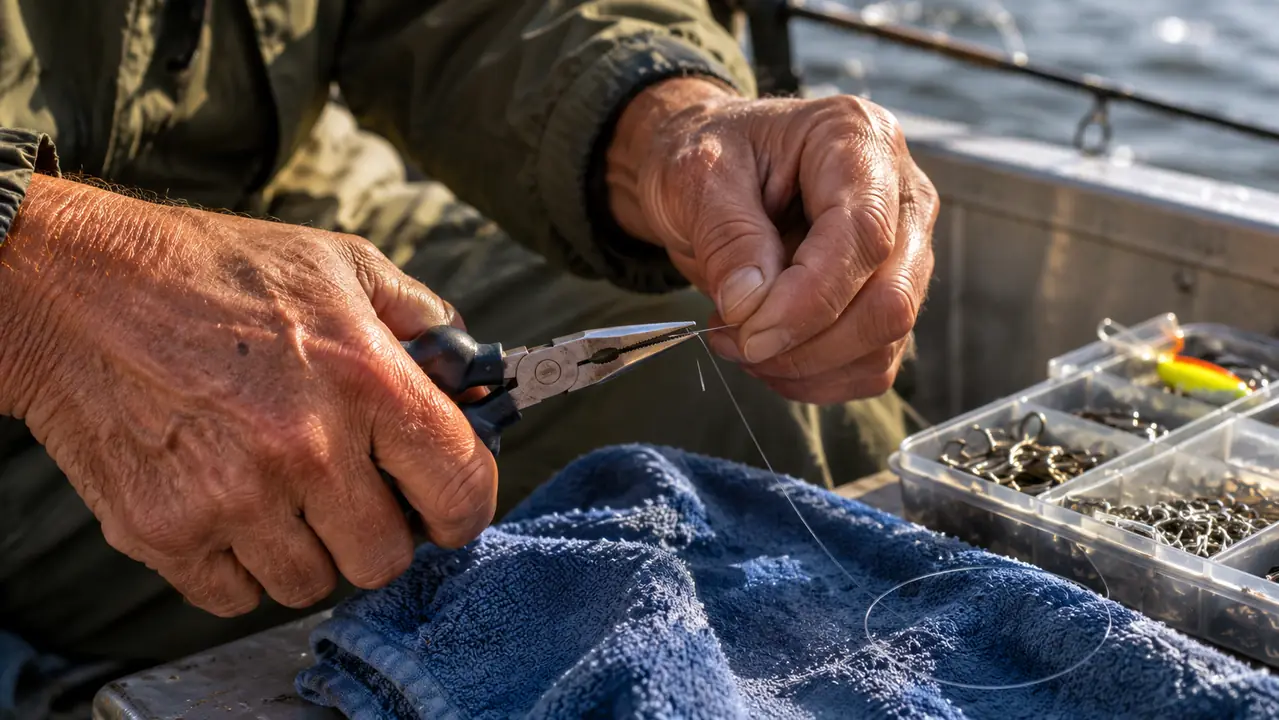
This is where the cutters set into the handle earn their keep. Hold the line taut between two fingers, get it down into the cutters, and close the jaws. They are built for braid and for mono and they go through both clean, which is more than I can say for the needle-nose pliers that used to live in my toolbox.
Two tries with the jaws, then the cutters. That is the rule I fish by now. It has saved more fish for me than any hook I ever bought, and it has kept me from standing in a boat for five minutes doing damage while I told myself I was almost there.
Step 5: Push the point through when that is the clean way out
There is a case where the neat answer is to push the point out through the skin on the far side, pinch off the barb, and back the hook out through the hole it already made. That works when the point is already tenting the skin and you can see it sitting there. It does not work when the point is buried in solid meat with no exit, and it does not work on a fish you plan to release if you are clumsy about it.
Pinching a barb down is the same motion as crimping, and crimping is one of the jobs these pliers are listed for. Close the jaws on the barb, squeeze it flat against the shank, then back the hook out through the hole it came in through. On my own lures I pinch the barbs down before the first cast now, especially on anything Tyler is going to throw, because a barbless hook comes out of a fish and out of a sweatshirt sleeve a whole lot easier.
When the hook is out, put the fish back in the water and hold it upright until it takes off under its own power. In the middle of July that can take a minute, and the boat can wait. Do not drop it over the side and hope for the best. If it rolls over on its side, pick it up and hold it again.
What Else Helps
A rubber net is worth the money. Hooks come out of rubber mesh without a fight, and a fish that is not tangled in nylon is a fish you can work on with two hands instead of one.
Clip the pliers to yourself. The coiled lanyard that comes with the X1 is not decoration. I have watched a pair of pliers go over the gunwale in six inches of chop, and I have no intention of doing it a second time. Lanyard on the vest, sheath on the belt, and the pliers go back to the same place every time you set them down.
Carry a wet towel and a few single hooks. Swapping the treble on a topwater for a single inline hook cuts the number of points you have to deal with from three to one, and it is easier on every fish you let go. If you fish with a kid, do that at the dock before the first cast, not after the first bad hookset.
A hook left in with a short tag of line will usually work loose and pass on its own. A hook that gets ripped around with a pair of pliers will not.
Pliers you can find with one wet hand in the dark
Booms Fishing X1 on a coiled lanyard, sheath on the belt, jaws and cutters where you left them. The twenty seconds you save is twenty seconds the fish gets back.
Amazon Check Today's Price on Amazon →