

The first time I spooled a spinning reel myself, I did everything wrong and did not know it until the line was already on there. I filled the spool off the side of a lying-down bulk spool, overfilled it past the lip, and then spent the next two Saturdays picking wind knots out of the guides. I was 30-something and assumed the reel was junk.
It was not the reel. It was the spooling. Line twist on a spinning reel comes from three things almost every time: line going onto the spool in the wrong direction, line going on with tension that changes from start to finish, and a spool filled to the wrong level. Get those three right and a spinning reel will cast about as clean as anything you can put in your hand. Get them wrong and even good line like Berkley Trilene XL will birdnest on you and you will blame the line. Here is the sequence I use now, on a garage floor, in about ten minutes.
The line I spool on everything from a 4-foot kids rod to my river rod
Berkley Trilene XL in 6-pound test, 330 yards, 0.22 millimeter diameter. Softer than most monofilament, which is exactly why it behaves on a spinning spool.
Amazon Check Today's Price on Amazon →Step 1: Match the line to the reel before you open anything
Before you spool, decide whether the line you bought belongs on that reel. A spinning reel has a spool diameter, and the line has to be flexible enough to come off it in coils that are not so tight they hold a memory. That is the whole reason baitcasters and spinning reels want different line. On a spinning reel, softer is generally friendlier.
The Berkley Trilene XL I keep on hand is 6-pound test, 330 yards, 0.22 millimeter diameter, monofilament, single strand. That diameter is a sensible match for the small and mid-size spinning reels I fish, which is most of them. The line runs from 2 pounds up to 30 pounds of break strength across the range, so if you are spooling a light panfish outfit you can go down and if you are spooling something beefier for smallmouth you can go up. The spec sheet lists 2.08 ounces for the spool, which tells you it is a compact 330-yard filler rather than a bulk box.
I learned this one the hard way. Two springs ago I put a heavier 12-pound mono on a small 1000-size reel because I wanted insurance around laydowns, and it cast like a slinky. The line was simply too stiff for a spool that small, so every cast peeled off in tight coils that jumped the guides. I stripped it that evening, went back to 6-pound Berkley Trilene XL on that reel, and the problem disappeared.
One practical note: monofilament has a shelf life. If a spool has been riding around in a hot truck bed for two summers, it will spool on crooked no matter how good your technique is. Buy fresh, or at least store it out of the sun.
Step 2: Get the filler on first so the line sits at the right height
Most spinning reels have a bare metal spool with a knurled band. Monofilament will slip on that bare metal under drag pressure, spinning the whole line mass around the spool arbor instead of letting the drag work. Two wraps of old line, electrical tape, or the little backing washer that came in the box solves it. I use a few feet of whatever cheap mono is lying around.
This backing also gets your line level right before you commit the good stuff. The target is simple: fill to within about one-sixteenth of an inch of the spool lip. Not flush, not under. Underfilled and you lose casting distance and the line has to climb a wall to leave the spool. Overfilled and the line spills off in loose loops the instant the bail opens, which is where most wind knots are born.
I keep a spare spool of cheap line in the garage just for this job. On the mid-size reels I use, somewhere between 20 and 40 yards of backing gets me close, and then I fine-tune the last bit. Do not guess the whole thing at once. Add backing in short stretches and hold the rod up to check the level after each one.
You do not need to measure. Spool the backing, then hold the spool up and look across the lip. You want a small step down, like a curb, not a cliff and not a flat surface.
Step 3: Find the right side of the spool and keep it there
This is the step that decides whether you fight twist all season. Lay the filler spool flat on the floor and watch the line as you turn the reel handle slowly. If the line coming off the filler spool is twisting into coils as it goes onto the reel, the spool is upside down. Flip it over and try again.
The test is visual and it takes five seconds. Coils going on means the label is facing the wrong way. Flat line going on means you have it right. On most spinning reels with the handle on the left, that ends up being the label facing up, but reels vary and it is not worth trusting a rule of thumb when your own eyes will tell you in one crank.
If you are spooling from a bulk spool on a pencil or a screwdriver, the same test applies, and you get the added benefit of being able to flip the whole thing without lifting it.
Step 4: Spool it under steady tension with a wet rag
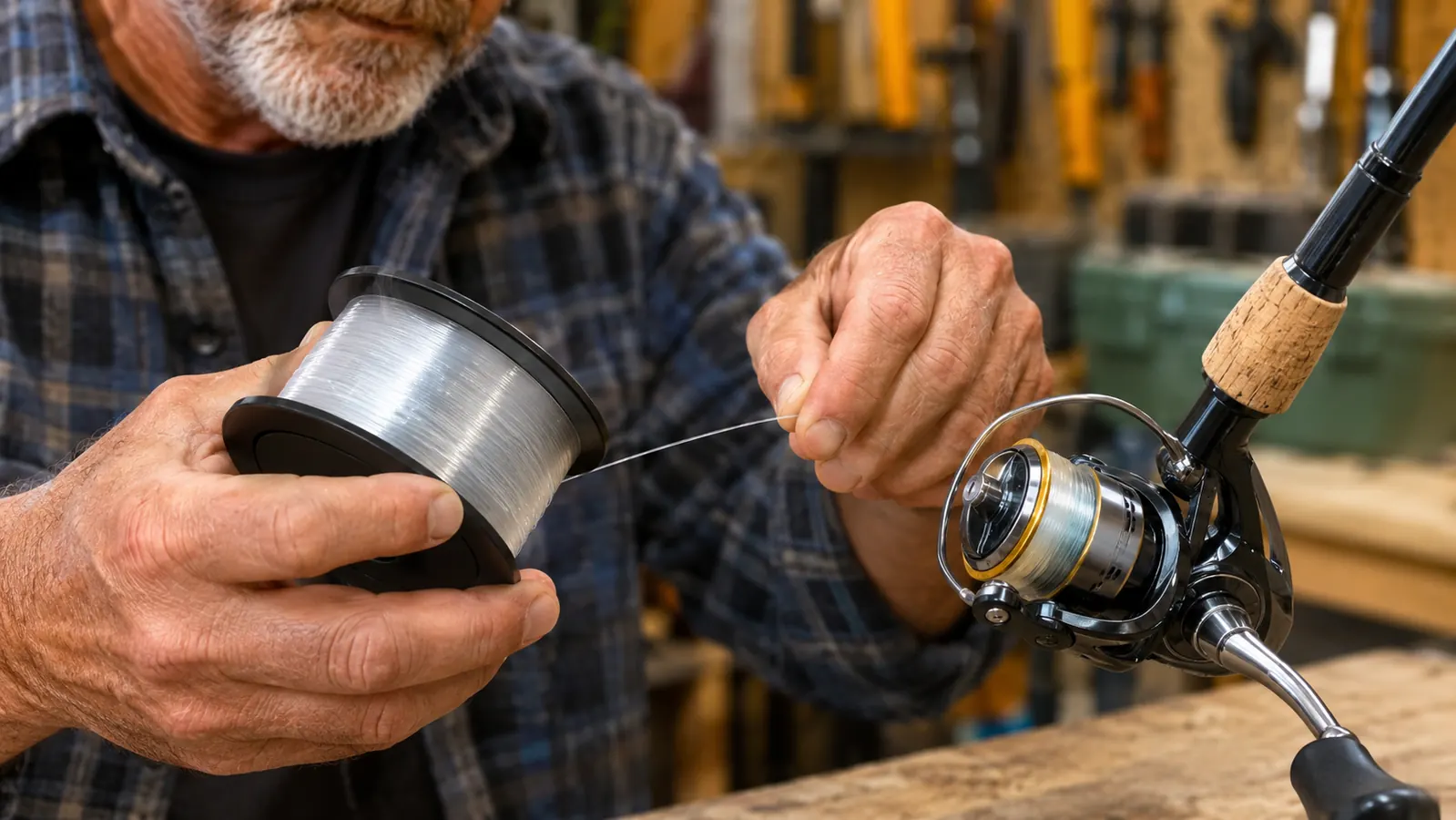
Pinch the line between your thumb and forefinger with a damp rag about two feet above the reel. Wet monofilament seats tighter and holds less memory than dry line going on. Then crank slowly and keep that same pinch pressure from the first wrap to the last.
The mistake here is starting tight and finishing loose, or the reverse. Inconsistent tension is what makes a spool that looks fine in the garage and turns into a loose birdnest on the third cast of the morning. Slow and even beats fast and hard. I would rather take three minutes on this than ten minutes untangling later.
Last June I rushed it on a Saturday before dawn, cranking fast with dry line and no rag, and by the second cast the line was coming off in loops. I cut back about 20 feet, re-spooled that last stretch slowly with a wet rag, and fished the rest of the morning without a single tangle. Same line, same reel, different ten minutes of prep.
Keep an eye on the level as you go. If the line is stacking on one side of the spool, the reel is not laying it evenly and you should stop and check that the spool is seated all the way down on the shaft. Berkley Trilene XL is soft enough that uneven stacking shows up quickly and dramatically, so it is a decent early warning.
Step 5: Cut it, tie it on, and take the twist out before you fish
When you are a sixteenth of an inch off the lip, stop. Cut the line, run it through the guides, and tie your lure or hook on with whatever knot you trust. Before you make a real cast, open the bail and strip off about 30 feet while holding the line lightly against the rod. That lets the line relax and any built-up twist unwind. Then reel it back in with your fingers on the line so it goes back on snug.
Do that once and you will notice the difference on the first cast. If the line still coils off the spool in a spiral when the bait hits the water, take the spool off the reel and soak it in a cup of warm water for a few minutes, then re-spool with tension. That is the last resort and it works, but you should not need it if you got steps 3 and 4 right.
Line twist is not bad luck and it is not a bad reel. It is the filler spool facing the wrong way, and it is a five-second fix.
What Else Helps
Fill your spool the night before, not in the boat. Monofilament takes a set, and letting it sit on the spool overnight lets that set form around the reel instead of fighting it. I spool in the garage, leave the rod leaning in the corner, and fish it the next morning.
Store your filler spools in a zipper bag inside the house, not in the boat hatch. A black hatch in July gets hot enough to soften monofilament, and soft line goes onto a spool loose no matter how careful you are with the rag.
Change line more often than feels reasonable. Monofilament is cheap and it degrades in UV and heat. On the reels I fish hardest, I will cut off the top 40 or 50 yards and re-spool that section mid-season rather than stripping the whole 330 yards. The backing stays, the working end is fresh, and the level stays right.
Learn one good line-to-line knot if you plan to do that partial re-spool. An Alberto or a double uni will pass through guides cleanly and holds fine on monofilament of similar diameter. Practice it on the kitchen table with two scrap pieces until you can tie it without thinking, because tying it on a rocking boat with cold hands is a different job.
And keep the rod tip up and the line wet when you are fishing. Wet line casts better and twists less. That is as true on a calm inland lake as it is on the piers at South Haven when the wind is coming across the water.
Where This Approach Falls Short
This sequence is built for monofilament on a spinning reel, and that is where it works best. If you are spooling braid, the backing step matters more because braid slips on a bare spool worse than mono does, and the tension has to be tighter than you think. Braid also has no stretch, so the tension you are feeling through your fingers reads differently.
It also assumes a filler spool with a label and a natural direction. Bulk spools, the big ones with no flat face, are harder to read and you will sometimes have to flip them twice to find the right orientation. On those, spool a few feet, look at the line, and trust your eyes over the spool's shape.
Finally, this will not rescue line that is already old. If the line has been cooked in a truck or on a dock for a couple of seasons, spooling it perfectly just gives you well-laid bad line. Fresh line and honest technique is the whole formula.

Who This Is For
Anybody running a spinning reel with monofilament, which covers a lot of bass and panfish fishing on small inland water. If you are teaching a kid to fish, this is the version to teach, because a properly spooled reel is the difference between a fun afternoon and 40 minutes of picking at a birdnest. My grandson Tyler is 12 and fishes a good bit of the summer with me, and the difference in his patience when his reel casts clean is not subtle.
It is also for anyone who has been blaming the reel. Spinning reels are simple machines and they are rarely the problem. Line choice and spooling discipline account for most of what people describe as a reel that will not cast.
330 yards of soft 6-pound mono that lays flat on a spinning spool
Berkley Trilene XL monofilament, 6-pound test, 0.22 millimeter diameter, 330 yards. Easy casting, and forgiving enough that a small spooling mistake does not ruin your morning.
Amazon Check Today's Price on Amazon →