

Most tackle box reviews are written by people who enjoy tackle boxes. I do not enjoy tackle boxes. I enjoy fishing, and I put up with whatever holds the lures. So when I tell you that the KastKing Utility Tackle Boxes have stayed in my boat for two full seasons while three other trays went to a shelf in the garage, understand that this is a bigger compliment than it sounds.
Context first, because a tackle tray review is only worth reading if you know how the person fishes. I am 61, retired out of a machine shop, and I live a little west of Kalamazoo. Most of my fishing is bass, bluegill and crappie out of a fourteen-foot aluminum jon boat with a trolling motor clamped on the back. Some trips I run the river for smallmouth. In spring and fall I fish the piers at South Haven. My grandson Tyler is twelve and comes along on some summer weekends, and he can undo an hour of organization in about ninety seconds. Any tray system I recommend has to survive him first and the fish second.
The Quick Verdict
Plain, workmanlike trays that have survived two seasons in a small boat. The adjustable dividers are both the reason to buy them and the reason you will mutter to yourself.
Amazon Check Today's Price →The trays that outlasted three others in my boat
KastKing Utility Tackle Boxes in the 3600 and 3700 footprints, adjustable from three compartments to eighteen, sized to drop into a standard tackle bag.
Amazon Check today's price on Amazon →How I Have Actually Used Them
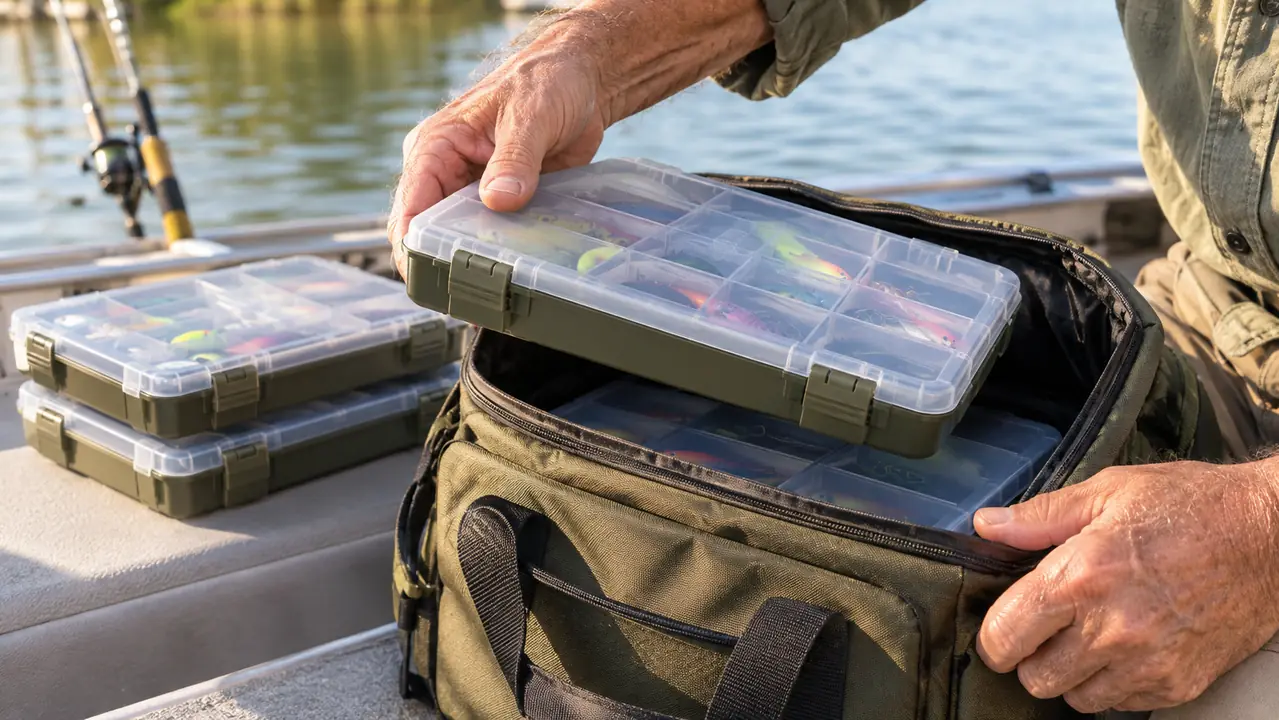
I run two of the 3600 trays in the bottom of a soft sided boat bag. One holds hard baits: a couple of square bills, three jerkbaits, and a spinnerbait I keep meaning to throw and never do. The other holds terminal tackle, and that is the tray that takes the abuse, because terminal tackle means split shot, hooks, swivels and the little pieces of lead that get wet and stay wet for the rest of the day.
The terminal tray is where I formed my opinion. It gets opened forty times a trip. It gets dropped on the bench. It gets rained on. One afternoon in August it got sat on, which is what happens when a twelve-year-old climbs back into the boat in a hurry. After two seasons it has not cracked, the dividers have not popped loose on their own, and the corners are still square. I cannot say that about the trays it replaced.
The other thing worth mentioning is that two trays stack and drop into the bag without a fight. That sounds trivial until you have owned trays that do not. The 3600 footprint is the size most soft bags are built around, and KastKing built to that footprint deliberately rather than inventing their own.
What I expected when I ordered them was a set of trays that felt like every other set of trays. What I got was a set that has stayed in service while others did not, plus two real annoyances I will spend most of this review on. That is the trade. If you want a review that says buy it and moves along, this is not that review. This is the one I would want to read before giving up an afternoon.
The Dividers Are the Reason to Buy Them, and the Catch
Each tray runs from three compartments up to eighteen, depending on how many of the pre-cut dividers you leave in place. The dividers are molded into the tray and you snap out whatever you do not want. Here is what nobody puts in the listing: that is a one-way trip. Once a divider is out, it does not go back in unless you are the sort of person who keeps plastic welding rod in the shop. I am that sort of person, and I still have not bothered.
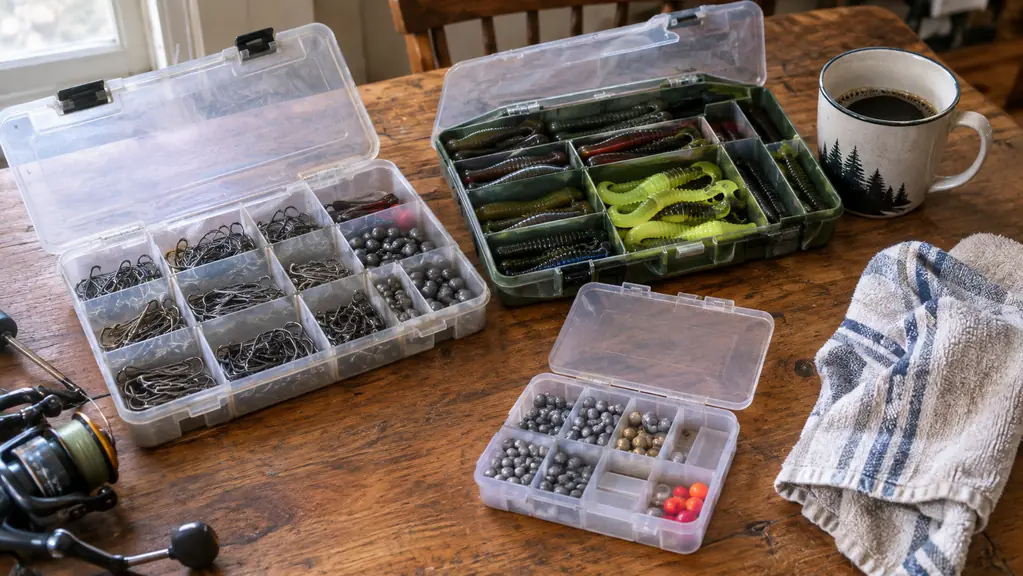
So plan the tray before you snap anything. I dumped my terminal tackle out on the bench, sorted it into piles, and figured out which slots needed to be wide and which needed to be narrow before I touched a single divider. Split shot and hooks went into the narrow slots. Swivels and snaps went into the wide ones, with room left over for a small pack of offset hooks. A friend of mine snapped dividers out by feel in the truck, and now he owns a tray with four long slots and nowhere to put a hundred size six hooks.
The honest complaint on this section is depth. The compartments are shallow enough that small split shot will jump the wall between slots on a rough ride, particularly when the boat takes a wake at an angle. That is not a defect, it is just physics and an inch and five eighths of tray height. I fixed it by keeping the loose lead in a small zip bag that sits inside the wide slot. It is ugly, it works, and it is the price of a tray thin enough to fit in a bag.
What Waterproof Actually Means on a Tray With This Many Slots
The listing rates these trays as waterproof, and the material is solid plastic, so I do not doubt the rating. What I would tell you is that a tray with eighteen compartments has a lot of walls and a lot of slots, and I treat any waterproof claim on a tackle tray the way I treat a marine forecast on Lake Michigan. Useful. Not a promise.
I have had rain in the boat, the kind that comes in sideways and soaks everything on the bench. I have also had a tray sit in an inch of water in the bottom of the boat all morning because I forgot the plug and did not notice until the bilge pump started talking to me. The terminal tackle came out wet. The tray did not fill up like a bucket, and nothing in it rusted through, because I spread everything on a towel that night and left it in the garage. If you are the type to leave a tray in the boat for a month at a time, water will find a way in there and it will stay.
Two seasons, one twelve-year-old, and about three pounds of lead and hooks, and the tray still stacks flat in the bag.
The Three-Pound Note in the Specs Is Not Decoration
The spec sheet lists a maximum recommended weight of three pounds per tray. Three pounds is roughly a pound and a half of lead plus hooks plus hardware, and it is easy to blow right past that without noticing, because lead is heavy and small and you keep dropping pieces into the slot until the tray is full.
A 3600 tray packed to the lid will bow when you pick it up by one end. I have not broken one, but I have felt it, and now I load the terminal tray to about two thirds and leave the rest of the lead in a bag in the locker. The tray is not weak. It is plastic, it is thin because it has to be to fit in a bag, and it is doing exactly what a thin plastic tray does when you put four pounds of lead in it and pick it up by a corner.
Where the 3600 Size Runs Out of Room
The 3600 tray measures ten point eight inches long, seven point two five inches wide, and one point six five inches deep. That last number is the one that limits you. I can lay a five-inch jerkbait flat with a little angle to spare, but a deep diving crankbait will not sit flat and it will push at the lid. If you throw big swimbaits or long musky baits, this is not your tray, and no amount of divider adjustment is going to fix depth.
KastKing builds the trays in both the 3600 and 3700 footprints, which are the two standard sizes that tackle bags are designed around. If your bag is set up for the larger footprint, buy the larger tray and be done with it. Mixing a 3600 into a bag built for 3700 wastes space and lets the small tray slide around. I know that because I did it for a month before I gave up and moved the 3600s into the front pocket of the bag.
One more thing that does not make it onto the listing. A fully loaded tray carried across a dock by itself is a two-hand job. I do not trust a lid alone on any tray I have ever owned, and I do not trust this one either, so I carry them flat and stacked and I keep them in the bag when I can. That is not a knock on KastKing. It is a knock on thin plastic and gravity.
What I Liked
- Adjustable from three compartments up to eighteen using pre-cut dividers, so one tray handles terminal tackle or hard baits
- The 3600 footprint drops into a standard soft tackle bag and stacks without fighting the tray above it
- Solid plastic that has survived two seasons of boat use, a twelve-year-old, and being sat on once
- Rated waterproof, and in practice it keeps splash and rain out of the compartments on a normal trip
- Light enough that four loaded trays do not change how the bag carries on your shoulder
Where It Falls Short
- Pre-cut dividers are a one-way decision. Snap one out and it stays out
- Compartments are shallow enough that split shot jumps the walls on a rough ride
- The three-pound weight recommendation is easy to exceed without realizing it
- A loaded tray carried on its own is a two-hand job
- The one point six five inch depth will not take larger crankbaits lying flat
What Held Up and What Did Not Over Two Seasons
What held up: the tray bodies, the dividers I left in, and the corners. The corners are the tell on cheap plastic, because that is where a tray cracks first when it gets dropped on gravel or concrete. These have been dropped on both, more than once, and the corners are still tight. The stack also still sits flat, which matters more than people think, because a warped tray will not seat in a bag and will not sit level in the boat.
What did not hold up: nothing structural, but the tray has picked up scratches and a couple of scuffs on the bottom from sliding around the boat. That is cosmetic and I do not care. What I do care about is that the wide slots I snapped out on the terminal tray turned out to be a little too wide and a little too few. If I were doing it again I would snap out fewer dividers on the first pass and live with it for a month before committing.
For comparison, the trays these replaced were the ones that came with an old bag. They lasted a season and a half before the lid on one stopped sitting flush and the dividers on the other started popping out on their own every time the boat hit a wake. That is the difference you are paying attention to here. Not whether a tray is perfect, but whether it is still doing its job after the new wears off and the boat has bounced across a lake forty times.
What Nobody Tells You Before You Buy Trays
I fished out of one big box for about fifteen years. The lesson I finally learned is that one big box is a single decision you make badly once and then live with for a decade. Trays let you make a lot of small decisions instead, and change your mind without replacing anything. That is the entire argument for tray style storage, and it is a better argument than any feature list.
If I were starting from nothing I would buy the trays first and the bag second. Most people do it backwards. They buy a bag with whatever trays came in it, then discover the trays are the wrong footprint and the dividers do not land where they want them. Start with the trays, lay out your actual tackle on the bench, and then pick a bag that fits what you built.
The other thing I would tell you is that two trays will not be enough. I started with two and I am at four, split by season. One for summer bass and panfish, one for river smallmouth, one for the pier in spring, one for terminal tackle. It is a lot easier to grab one tray and put it in the bag than it is to dig through one big box at the ramp looking for a specific hook while somebody else is waiting to use the launch.
Who This Is For
This is for the angler who carries gear in a bag and actually wants it sorted. If you fish from a small boat or from shore, if you load and unload every trip, and if you have ever spent ten minutes at a ramp digging for a hook you know is in there somewhere, these trays solve that problem. The 3600 footprint is also the right size for a bag that rides in the back of a truck and gets carried a few hundred yards to the water.
It is also a good fit if you fish with a kid. You can hand a twelve-year-old one tray and tell him his mess lives in it, and it stays out of yours. Tyler has his own tray now. It is a disaster inside, but it is a contained disaster, and it costs me nothing to hand it to him at the start of a trip.
Who Should Skip It
Skip it if you throw big baits. The depth will fight you on every trip and you will end up laying lures in at an angle or leaving them home. Skip it if you want one box that lives in the garage shelf and holds everything you own, because the entire point of a tray is that it lives in a bag and travels. And skip it if you are the kind of person who snaps out every divider in the first ten minutes and then wants them back, because you will not get them back, and you will be annoyed about it for years.
One last thing, and it is the fair warning. If you mostly fish one lake with one technique and four lures, a single tray will do everything you need and a set of them is more organization than the job requires. KastKing sells these in packs, and a pack is only a good deal if you are actually going to sort. I sort. If you do not, buy less.
If you are going to sort your tackle, sort it once
Start with the trays and then pick the bag. Two 3600 trays cover terminal tackle and hard baits for a small boat, and they will still be flat and square next season.
Amazon See the current price on Amazon →